
Cinema Paradiso
1988 · Italy, France · 155 min
- Director
- Giuseppe Tornatore
- Screenplay
- Giuseppe Tornatore
- Producer
- Franco Cristaldi
- Music
- Ennio Morricone
- Cinematography
- Blasco Giurato
- Editing
- Mario Morra
- Production company
- Les Films Ariane
Awards: Academy Award for Best International Feature Film; Cannes Film Festival Grand Prix; European Film Award for Best Actor; Silver nugget for the best foreign film; European Film Academy Special Jury Award · 5 nominations
Cast
What it is about
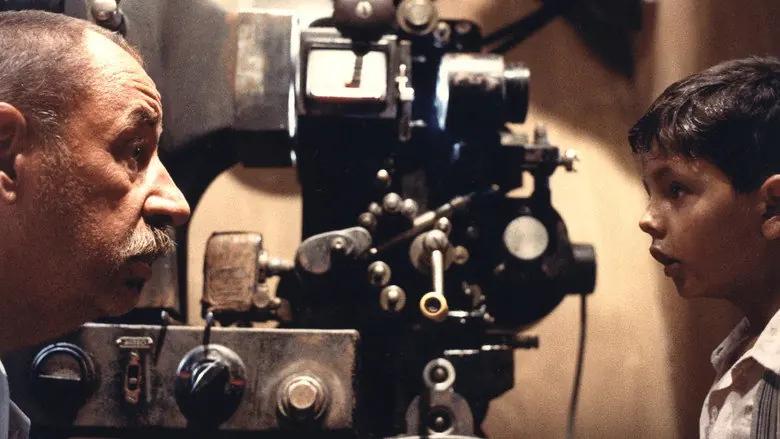
Rome, the 1980s. Salvatore Di Vita, an acclaimed film director, receives word that Alfredo, an old figure from his past, has died. The news takes him back to Giancaldo, the Sicilian village where he grew up and which he has not visited in decades. Along the way, he remembers how as a boy he discovered his love of cinema at the local movie house, Cinema Paradiso, and how its projectionist became his closest mentor. The story moves between the present and those recollections, focusing on an unlikely friendship between a curious child and an older man who teaches him a trade and a way of seeing.
How it was made
The film is an Italian-French co-production, with Franco Cristaldi as producer and Les Films Ariane as production company. Giuseppe Tornatore wrote and directed it, and shooting took place in Sicily, in locations including Bagheria, his hometown, Cefalù and Palazzo Adriano, where the village square was set. Filming ran from December 1987 to September 1988. Ennio Morricone composed the score, with his son Andrea contributing as well, and the collaboration between Morricone and Tornatore lasted until the composer's death in 2020. Critics have noted its mix of sentiment and comedy, and of nostalgia and pragmatism, a approach some describe as nostalgic postmodernism. The original 155-minute cut performed poorly in Italy, so a shorter international version of about 124 minutes was prepared, and it did far better. A 173-minute director's cut was released in 2002.
Reception and legacy
It opened in Italy in November 1988 and did modest business at home, while the shorter international cut travelled much further abroad. It was picked for the Panorama section of the 1989 Berlin festival, but Tornatore and his producer withdrew it after the festival's artistic director, in an interview with La Stampa, made unflattering remarks comparing it unfavourably with Ettore Scola's Splendor. It then competed at Cannes, where it won a jury prize, and it went on to win the Academy Award for Best Foreign Language Film. Many now regard it as a classic, and it is credited with helping to revitalise Italian cinema of the period. Its ending is especially remembered by audiences and critics alike.
Stills


Trailer
Clicking loads the video from YouTube (privacy-enhanced mode). Open on YouTube
Trivia
A withdrawal in Berlin
After remarks by the Berlin festival's artistic director about the film, Tornatore and Cristaldi chose to pull it from the Panorama section.
A BAFTA record
It won five of its eleven BAFTA nominations, including Best Foreign Language Film, a record for a foreign-language feature until All Quiet on the Western Front broke it in 2023.
More films by Giuseppe Tornatore
 The Best Offer
 Malèna
 The Unknown Woman
 The Legend of 1900
 Everybody's Fine
 Baarìa
Original Cinematopedia text based on Wikipedia (es) and Wikipedia (en) and Wikidata.