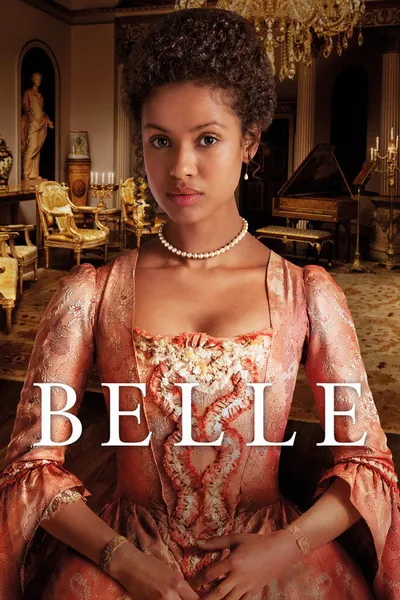
Belle
2013 · United Kingdom · 104 min
- Director
- Amma Asante
- Screenplay
- Misan Sagay
- Producer
- Damian Jones
- Music
- Rachel Portman
- Cinematography
- Ben Smithard
- Editing
- Pia Di Ciaula
Cast
What it is about
In eighteenth-century England, Dido Elizabeth Belle, the mixed-race daughter of a Royal Navy officer, is taken in by her great-uncle William Murray, Earl of Mansfield and Lord Chief Justice, and his wife at their country house, Kenwood House, outside London. Raised as a young lady of good standing alongside her cousin Elizabeth, Dido finds that her background limits her prospects. Meanwhile, a court case over the killing of enslaved people aboard the ship Zong occupies her uncle, drawing her into a conflict between her conscience, her affections and her family's expectations.
How it was made
The project drew on the 1779 portrait of Dido Belle beside her cousin Elizabeth Murray, although Misan Sagay's screenplay is a fiction that takes liberties with a biography about which little is known. Director Amma Asante worked with producer Damian Jones on the British production. Filming began in September 2012 and took place on the Isle of Man, in Oxford and in London, with a re-creation of eighteenth-century Bristol docks. The film is noted for Ben Smithard's cinematography and Rachel Portman's score. It was also shot in true 4K, a first for a major British feature. The cast includes Gugu Mbatha-Raw, Tom Wilkinson, Emily Watson and Miranda Richardson.
Reception and legacy
Belle was generally well received by critics and audiences as a period drama that brings attention to a little-known figure in British history. Its main interest lies in its treatment of slavery and the social position of a mixed-race woman in high society. Some commentators noted that the romantic storyline dilutes the historical record, so the film is better understood as a fictionalised reinterpretation than as a documentary. Its place in film history rests largely on giving visibility to Dido Belle and on revisiting the legal context that led to the Zong ruling.
Stills


Trailer
Clicking loads the video from YouTube (privacy-enhanced mode). Open on YouTube
Trivia
4K shoot
The film was the first major British motion picture shot in true 4K, using Sony's F65 CineAlta digital camera.
The original painting
The film shows a replica of the portrait with the actresses' faces, and the original picture appears at the end.
More films by Amma Asante
 A United Kingdom
 Where Hands Touch
Original Cinematopedia text based on Wikipedia (es) and Wikipedia (en) and Wikidata.