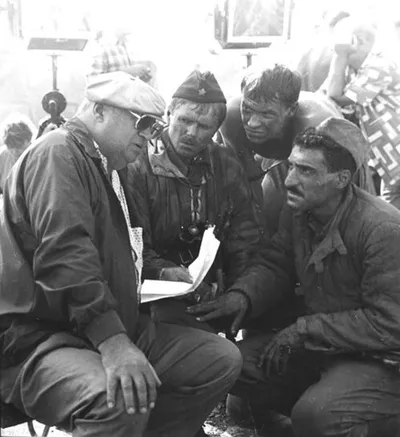
Yuri Ozerov
1921–2001 · Soviet film director and screenwriter
Biography
Yuri Ozerov (Moscow, 1921 - 2001) was a Soviet director and screenwriter best known for his large-scale films about the Second World War. He directed twenty films between 1950 and 1995, and his career unfolded largely within the official Soviet film system.
During the war he served in the Red Army, took part in the Battle of Moscow and in the campaigns in Ukraine and Poland, and was discharged in 1945 with the rank of major. He resumed his studies afterwards and entered the All-Union Cinematography Institute in 1947, where he worked alongside future filmmakers such as Aleksandr Alov and Sergei Parajanov. He made his debut with Alexander Pushkin in 1950 while still a student. His early output included documentaries, and in 1953 he co-directed Arena of the Bold with Sergei Gurov. His first major feature was Son (1955). Fortuna (1959), an Albanian-Soviet co-production he made with Kristaq Dhamo, was his first film about the war, and in 1962 he directed The High Road, a biopic of Jaroslav Hasek.
His most ambitious project was Liberation, a five-part series shot between 1967 and 1971 as a Soviet answer to The Longest Day. Ozerov co-wrote the script and directed the series, which earned him the Lenin Prize. In 1973 Visions of Eight, a documentary on the Munich Olympics whose first part he directed, won the Golden Globe for Best Documentary. He later chaired the artistic committee for the 1980 Moscow Olympics, and in 1985 he released The Battle of Moscow for the fortieth anniversary of Victory Day. His last major war epic was Stalingrad (1989), which needed Warner Bros. for part of its budget.
Ozerov died shortly after receiving the Russian President's award for his contribution to national cinema in 2001. He is buried at Vvedenskoye Cemetery, next to his brother Nikolai, and his widow founded a war film festival in his memory.
Key films
- Liberation (1970)
- Fortuna (1959)
- The Battle of Moscow (1985)
- Stalingrad (1989)
Trivia
A co-production with conditions
To help finance Stalingrad, Warner Bros. agreed only on the condition that American actors would take major roles. Ozerov, reluctant, had to cast Powers Boothe as General Chuikov.
A Golden Globe for a documentary
Visions of Eight, whose first part Ozerov directed on the Munich Olympics, won the 1973 Golden Globe for Best Documentary.
On Cinematopedia
 Velká cesta
Original Cinematopedia text based on Wikipedia (es) and Wikipedia (en) and Wikidata.