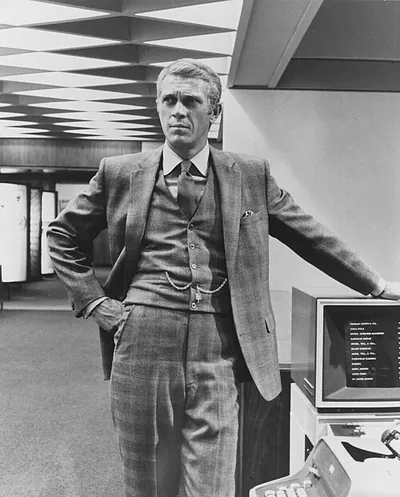
Steve McQueen
1930–1980 · American actor, nicknamed 'The King of Cool'
Biography
Terrence Stephen McQueen, known as Steve McQueen, was an American actor born in Beech Grove, Indiana, on March 24, 1930, and who died in Ciudad Juárez, Mexico, on November 7, 1980. His career ran from the late 1950s to the mid-1970s, and he is remembered as one of the defining Hollywood stars of that period. His antihero image, closely tied to the counterculture of the 1960s, made him one of the most reliable box office draws of his day. In 1969 he became the highest-paid movie star in the world, and the nickname 'The King of Cool' captures the screen persona he built.
His childhood was unsettled. Raised by his mother, Julia Ann Crawford, after his father, a stunt pilot with a flying circus, left the family, he was sent to live with relatives in Slater, Missouri, in 1933. He remembered his great-uncle Claude's farm fondly, and he later linked his early fascination with racing cars to a red tricycle that Claude gave him. When his mother remarried, he moved back to Indianapolis, but the relationship with his stepfather was violent. Dyslexic and partly deaf, he struggled at school and, at nine, left home to live on the streets. He drifted into a gang and petty crime, and was eventually placed at the Boys Republic in Chino Hills, where he rose to a position of responsibility among the residents and later kept up ties with the institution.
His teenage years were restless, with a string of odd jobs and a spell in a chain gang after a vagrancy arrest. In 1947 he enlisted in the U.S. Marines. His record was uneven: he was demoted several times and served a brig sentence after an unauthorized absence. Over time he settled into the service, and by his own account it shaped him. He was honorably discharged in 1950.
Back in civilian life, he used veterans' education benefits to study acting in New York, at the Neighborhood Playhouse, at HB Studio under Uta Hagen and with Stella Adler. He supported himself with weekend motorcycle racing. His early work was in small stage parts, and he made his Broadway debut in 1955 in A Hatful of Rain. That same year he moved to Los Angeles, where television work opened the door to film.
His first films were low-budget features such as Somebody Up There Likes Me (1956) and The Blob (1958), but his breakthrough came with the television series Wanted: Dead or Alive (1958-1961), which made him popular in the United States and abroad. Mainstream hits followed, among them The Magnificent Seven (1960) and The Great Escape (1963). His work in Bullitt (1968) cemented a persona of quiet competence and gave the action genre one of its best-known car chases. Later he made more personal projects such as Le Mans (1971), reflecting his passion for motor racing, and Papillon (1973), opposite Dustin Hoffman.
He was a difficult collaborator on set and often clashed with directors and producers, but his popularity let him command very large salaries. After The Towering Inferno (1974), a major box office success, he did not appear in another film for four years. In 1980, while seriously ill with cancer, he travelled to Mexico for surgery that US doctors had advised against, and he died shortly after the operation. His legacy lives on in the action cinema he helped shape and in his spare, understated screen presence. His son Chad and grandson Steven R. McQueen also became actors.
Key films
- Somebody Up There Likes Me (1956): his first film role, in a production directed by Robert Wise.
- The Blob (1958): his first leading role in a feature, in a science fiction classic.
- The Magnificent Seven (1960): one of his most recognised ensemble roles.
- The Great Escape (1963): part of a large cast, he became well known for a motorcycle sequence.
- Bullitt (1968): his San Francisco police lieutenant, and its celebrated car chase.
- Papillon (1973): opposite Dustin Hoffman, in a story about escape from a prison in French Guiana.
Trivia
A childhood gift
His great-uncle Claude gave him a red tricycle when he was four, which McQueen later linked to his passion for racing cars.
A racing alias
When he took part in motor races he used the alias 'Harvey Mushman'.
On Cinematopedia
 The Towering Inferno1974
 The Magnificent Seven1960
 The Great Escape1963
 Bullitt1968
 Papillon1973
 The Sand Pebbles1966
 The Getaway1972
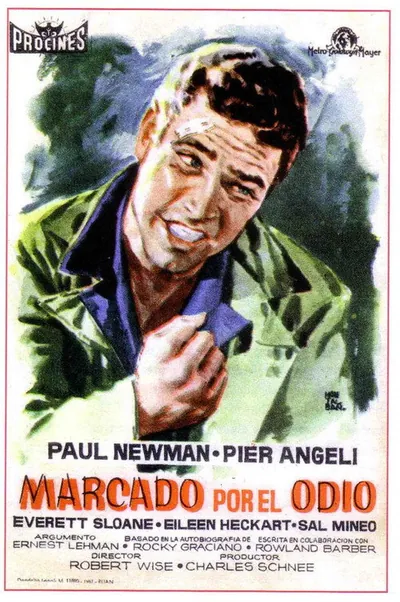 Somebody Up There Likes Me1956
 The Thomas Crown Affair1968
 The Blob1958
 The Cincinnati Kid1965
 Nevada Smith1966
- Somebody Up There Likes Me 1956 · cast
- The Blob 1958 · cast
- Never So Few 1959 · cast
- The Great St. Louis Bank Robbery 1959 · cast
- The Magnificent Seven 1960 · cast
- Hell Is for Heroes 1962 · cast
- The War Lover 1962 · cast
- The Great Escape 1963 · cast
- Love with the Proper Stranger 1963 · cast
- The Cincinnati Kid 1965 · cast
- The Sand Pebbles 1966 · cast
- Nevada Smith 1966 · cast
- Bullitt 1968 · cast
- The Thomas Crown Affair 1968 · cast
- The Reivers 1969 · cast
- Le Mans 1971 · cast
- The Getaway 1972 · cast
- Junior Bonner 1972 · cast
- Papillon 1973 · cast
- The Towering Inferno 1974 · cast
- An Enemy of the People 1978 · cast
- Tom Horn 1980 · cast
- The Hunter 1980 · cast
Original Cinematopedia text based on Wikipedia (es) and Wikipedia (en) and Wikidata.