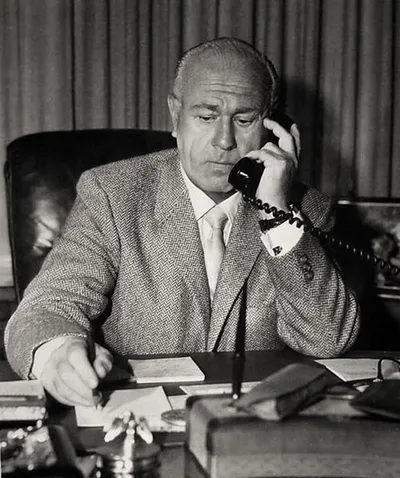
Sol C. Siegel
1903–1982 · American film producer
Biography
Sol C. Siegel (born in Kalvarija, then part of the Russian Empire, on March 30, 1903; died in Los Angeles on December 29, 1982) was an American film producer who worked at several major Hollywood studios during the 1940s and 1950s. His career belongs to the studio era, when the big companies controlled much of production and distribution.
He arrived in Hollywood in 1934, helping his brother Moe Siegel merge several small studios into Republic Pictures. There he worked as an executive producer alongside Gene Autry and John Wayne. In 1940 he moved to Paramount and in 1946 to 20th Century Fox, where he produced A Letter to Three Wives, nominated for the Best Picture Oscar, and Gentlemen Prefer Blondes. In 1956 he joined Metro-Goldwyn-Mayer, producing High Society, and in 1958 he took charge of studio operations, until he was replaced in 1962 after a run of costly box office failures.
After leaving MGM he worked as an independent producer and ran his own company from 1964 to 1967. He was married to Ruth Shor until her death in 1962, and the couple had three sons. He is remembered mainly for the era in which studios favoured large-scale spectacle and big musicals.
Key films
- A Letter to Three Wives (1949), 20th Century Fox production nominated for the Best Picture Oscar.
- Gentlemen Prefer Blondes (1953), musical starring Marilyn Monroe, produced for 20th Century Fox.
- High Society (1956), MGM musical remake starring Frank Sinatra, Grace Kelly and Bing Crosby.
- Alvarez Kelly (1966), Columbia western starring William Holden and Richard Widmark, made during his independent period.
Trivia
The Roy Rogers name
According to accounts of a contract dispute between Republic and Gene Autry, Siegel brought in a member of The Sons of the Pioneers, Leonard Slye, and changed his screen name to Roy Rogers.
Re-releases every seven years
After the success of Ben-Hur, Siegel backed a series of MGM remakes, such as Cimarron and Four Horsemen of the Apocalypse, planned for re-release every seven years, as the studio had done with Gone with the Wind.
Flops that cost him the job
Four Horsemen of the Apocalypse and Mutiny on the Bounty were among the most expensive films of his MGM period and among its biggest box office failures, and they are generally seen as contributing to his removal in 1962.
On Cinematopedia
 A Letter to Three Wives1949
 Gentlemen Prefer Blondes1953
 Les Girls1957
 Panic in the Streets1950
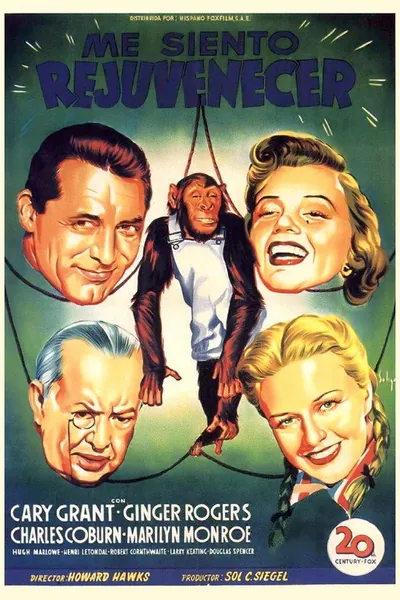 Monkey Business1952
 Some Came Running1958
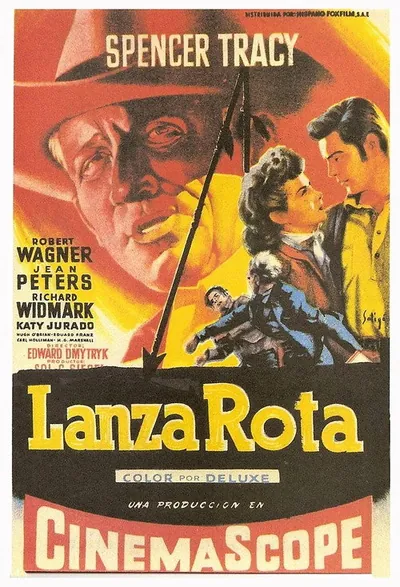 Broken Lance1954
 Three Coins in the Fountain1954
 Fourteen Hours1951
 High Society1956
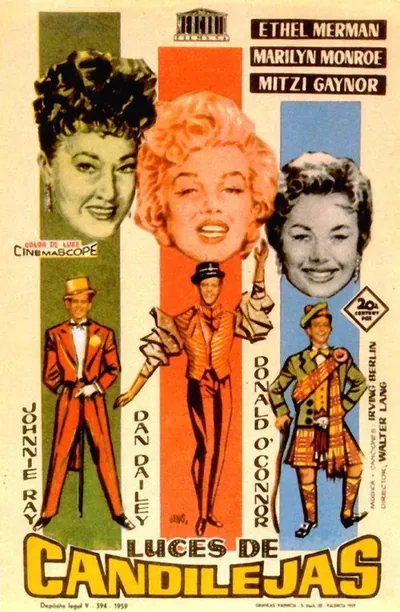 There's No Business Like Show Business1954
 Alvarez Kelly1966
- Zorro Rides Again 1937 · producer
- Hit the Saddle 1937 · producer
- Army Girl 1938 · producer
- Under Western Stars 1938 · producer
- Man of Conquest 1939 · producer
- Dark Command 1940 · producer
- Three Faces West 1940 · producer
- Dr. Broadway 1942 · producer
- Blue Skies 1946 · director, producer
- The Perils of Pauline 1947 · producer
- Cry of the City 1948 · producer
- The Iron Curtain 1948 · producer
- A Letter to Three Wives 1949 · producer
- House of Strangers 1949 · producer
- Prince of Foxes 1949 · producer
- Panic in the Streets 1950 · producer
- I Was a Male War Bride 1950 · producer
- Fourteen Hours 1951 · producer
- On the Riviera 1951 · producer
- Monkey Business 1952 · producer
- Deadline – U.S.A. 1952 · producer
- What Price Glory 1952 · producer
- Gentlemen Prefer Blondes 1953 · producer
- The President's Lady 1953 · producer
- Call Me Madam 1953 · producer
- Broken Lance 1954 · producer
- Three Coins in the Fountain 1954 · producer
- There's No Business Like Show Business 1954 · producer
- High Society 1956 · producer
- Les Girls 1957 · producer
- Some Came Running 1958 · producer
- The World, the Flesh and the Devil 1959 · producer
- Alvarez Kelly 1966 · producer
- Walk, Don't Run 1966 · producer
- No Way to Treat a Lady 1968 · producer
Original Cinematopedia text based on Wikipedia (en) and Wikidata.