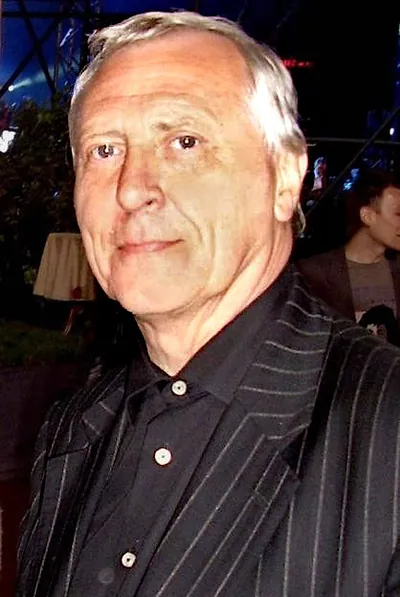
Peter Greenaway
b. 1942 · British filmmaker, screenwriter and producer
Biography
Peter Greenaway (born in Newport, Wales, in 1942) is a British filmmaker trained as a painter. His work, built on carefully composed images, made him one of the most distinctive British directors of the 1980s and 1990s, and it extends into video, installation and multimedia projects.
As a teenager he wanted to be a painter and grew fond of European cinema, above all Bergman, Godard and Alain Resnais. In 1962 he started at the Walthamstow College of Art, where a fellow student was the musician Ian Dury. His first short, Death of Sentiment, was shot in four London cemeteries. From 1965 he spent fifteen years at the Central Office of Information, making experimental shorts such as Train and Tree. His first feature, The Falls (1980), is an absurdist encyclopaedia of ninety-two victims of a so-called Violent Unknown Event.
The 1980s brought his best-known films: The Draughtsman's Contract (1982), The Belly of an Architect (1987), Drowning by Numbers (1988) and The Cook, the Thief, His Wife & Her Lover (1989), his most popular picture. His films are marked by meticulous staging inspired by Renaissance, Baroque and Mannerist painting, and by contrasts between nudity and costume, nature and architecture, sexual pleasure and violent death. During this period he often worked with composer Michael Nyman.
In the 1990s he made Prospero's Books (1991), an adaptation of Shakespeare's The Tempest, followed by the controversial The Baby of Mâcon (1993), The Pillow Book (1996) and 8½ Women (1999). He then devoted himself to The Tulse Luper Suitcases (2003-2005), a multimedia project that produced three films, a website, books and a touring exhibition. Nightwatching (2007), about Rembrandt's The Night Watch, followed. He has also worked in television, including A TV Dante (1989).
In 2014 he received the BAFTA Outstanding British Contribution to Cinema Award. He lives in Amsterdam. Greenaway's legacy lies on the border between cinema, painting and contemporary art. He argues that cinema has not yet shown what it can become, and that ambition keeps him one of the most debated figures in British film.
Key films
- The Draughtsman's Contract (1982): a key title of the 1980s and one of Greenaway's most studied works.
- The Belly of an Architect (1987): one of the major films of his best-known period, in which painting and architecture structure the story.
- Drowning by Numbers (1988): a 1980s work that confirms his interest in numerical structures and formal play.
- The Cook, the Thief, His Wife & Her Lover (1989): his best-known film with audiences and the most commercially successful of his career.
- Prospero's Books (1991): an adaptation of Shakespeare's The Tempest in which he explored the visual possibilities of the screen.
Trivia
Classmates
Ian Dury studied alongside Greenaway at the Walthamstow College of Art. Years later, the musician was cast in The Cook, the Thief, His Wife & Her Lover.
A set in cemeteries
His first short, Death of Sentiment, was filmed in four large London cemeteries, using crosses, angels and carved stones.
A disappearing train
Train (1966) gathered footage of the last steam trains to arrive at Waterloo station, which stood just behind his workplace.
On Cinematopedia
 The Cook, the Thief, His Wife & Her Lover1989
 The Draughtsman's Contract1982
 The Pillow Book1996
 Drowning by Numbers1988
 Lumière and Company1995
 A Zed & Two Noughts1985
 The Baby of Mâcon1992
 8½ Women1999
 The Belly of an Architect1987
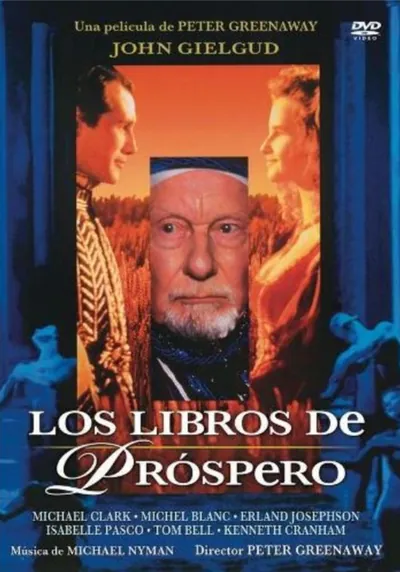 Prospero's Books1991
 Nightwatching2007
 Goltzius and the Pelican Company2012
- The Falls 1980 · director, screenplay, editing, cast
- The Draughtsman's Contract 1982 · director, screenplay
- A Zed & Two Noughts 1985 · director, screenplay
- The Belly of an Architect 1987 · director, screenplay
- Drowning by Numbers 1988 · director, screenplay
- The Cook, the Thief, His Wife & Her Lover 1989 · director, screenplay
- Prospero's Books 1991 · director, screenplay, producer
- The Baby of Mâcon 1992 · director, screenplay
- Lumière and Company 1995 · director
- The Pillow Book 1996 · director, screenplay, editing
- 8½ Women 1999 · director, screenplay, cast
- Visions of Europe 2004 · director, screenplay
- Nightwatching 2007 · director, screenplay
- Rembrandt's J'Accuse 2008 · director, screenplay, cast
- Goltzius and the Pelican Company 2012 · director, screenplay
- Eisenstein in Guanajuato 2015 · director, screenplay
Original Cinematopedia text based on Wikipedia (es) and Wikipedia (en) and Wikidata.