
Olivia de Havilland
1916–2020 · British-American actress and Hollywood star
Biography
Dame Olivia de Havilland (Tokyo, July 1, 1916 - Paris, July 26, 2020) was a British-born actress who became an American citizen and, at different points in her life, also held British and French nationality. She was one of Hollywood's leading stars of the 1930s and 1940s and the last major survivor of its classic studio era. Two Academy Awards for Best Actress place her among the most honored performers of her generation.
The eldest daughter of British parents, she was born in Japan, where her father worked as a lawyer. After her parents separated and her health gave cause for concern, her mother moved her and her younger sister to California, settling in the town of Saratoga. Her mother, an actress, gave her a thorough grounding in the arts, with ballet and piano lessons from an early age and recitations of Shakespeare to sharpen her diction. As a teenager her love of school drama brought her into conflict with her stepfather, who forbade her extracurricular activities. When she won the lead in a school production of Pride and Prejudice, she chose to leave home rather than give up the part. In 1934 the Austrian director Max Reinhardt cast her as Hermia in his staging of A Midsummer Night's Dream and then brought her into the Warner Bros. film version. She signed a five-year contract with the studio that same year.
Her early work at Warner consisted of romantic heroine roles in adventure films. She was paired with Errol Flynn in seven pictures, many directed by Michael Curtiz, among them Captain Blood (1935) and The Charge of the Light Brigade (1936), always playing the hero's loyal sweetheart. Her portrayal of Melanie Hamilton in Gone with the Wind (1939) earned her a nomination for Best Supporting Actress. Unhappy with the parts she was offered, and convinced the best ones went to Bette Davis, she clashed with the studio, which kept her idle for six months. When Warner tried to extend her contract to make up for that lost time, she sued. She won the case, but she spent almost three years without work.
The 1940s brought more demanding roles. She was nominated for Hold Back the Dawn (1941) and The Snake Pit (1948), and she won her two Oscars for To Each His Own (1946), directed by Mitchell Leisen, and for The Heiress (1949), William Wyler's film opposite Montgomery Clift. Her younger sister, Joan Fontaine, also won the Best Actress Oscar, for Suspicion, and the rivalry between the two was closely followed by the press. De Havilland also worked on stage, appearing three times on Broadway, and later in television, where she was acclaimed for Anastasia: The Mystery of Anna (1986), which won her a Golden Globe.
From the 1950s she lived mostly in Paris, and her film appearances became less frequent. Her later films include Not as a Stranger (1955), directed by Stanley Kramer, and The Swarm (1978). She received honors including the National Medal of the Arts and the French Légion d'honneur. In 2017, at the age of 100, she was made a Dame Commander of the Order of the British Empire by Queen Elizabeth II, the oldest person ever to receive that honor. Her legacy rests on her partnership with Flynn and Curtiz, her performances of the 1940s and her position as one of the last great stars of classic Hollywood.
Key films
- Captain Blood (1935): the first of seven films with Errol Flynn, playing the hero's sweetheart.
- The Adventures of Robin Hood (1938): another swashbuckler with Flynn, in which she plays a noblewoman who follows the outlaw hero.
- Gone with the Wind (1939): her role as Melanie Hamilton brought her worldwide fame and an Oscar nomination.
- The Snake Pit (1948): nominated for her portrayal of a patient in a psychiatric hospital, a far cry from her earlier heroine parts.
- To Each His Own (1946): her first Oscar, for a role as an unmarried mother in wartime America.
- The Heiress (1949): her second Oscar, for a portrait of a woman dominated by her father in nineteenth-century New York.
Trivia
A rivalry with her sister
Olivia and Joan Fontaine were rivals for years, and the press followed their feud closely. The estrangement was especially visible at the Oscars, when Joan turned down her sister's congratulations as she went up to collect her award.
A lawsuit against Warner
After a dispute in which the studio kept her away from filming for more than six months, she won the lawsuit she brought against Warner Bros. Even so, she spent nearly three years without work.
On Cinematopedia
 Gone with the Wind1939
 The Adventures of Robin Hood1938
 The Heiress1949
 Anthony Adverse1936
 The Snake Pit1948
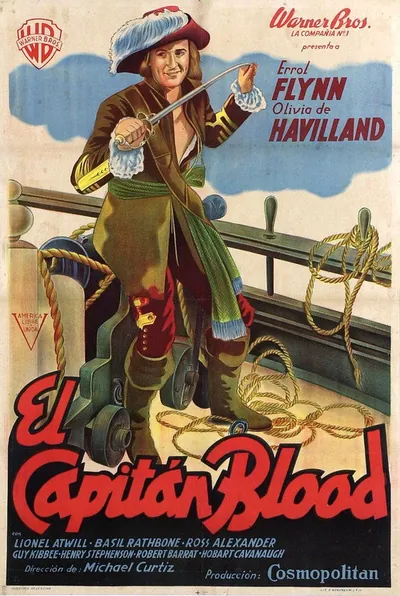 Captain Blood1935
 A Midsummer Night's Dream1935
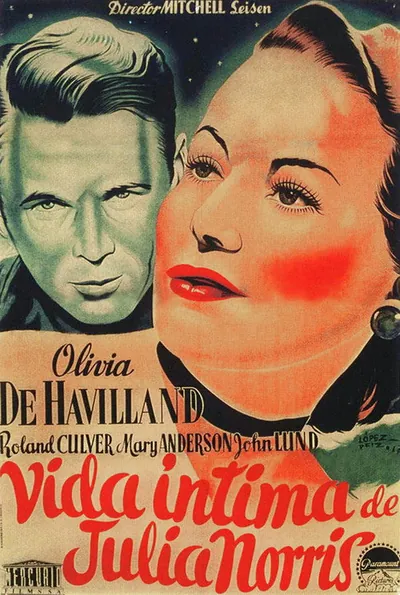 To Each His Own1946
 The Private Lives of Elizabeth and Essex1939
 Airport '771977
 Hush...Hush, Sweet Charlotte1964
 Hold Back the Dawn1941
- Captain Blood 1935 · cast
- A Midsummer Night's Dream 1935 · cast
- The Irish in Us 1935 · cast
- Anthony Adverse 1936 · cast
- The Charge of the Light Brigade 1936 · cast
- It's Love I'm After 1937 · cast
- The Great Garrick 1937 · cast
- The Adventures of Robin Hood 1938 · cast
- Four's a Crowd 1938 · cast
- Gold Is Where You Find It 1938 · cast
- Gone with the Wind 1939 · cast
- The Private Lives of Elizabeth and Essex 1939 · cast
- Dodge City 1939 · cast
- Wings of the Navy 1939 · cast
- Santa Fe Trail 1940 · cast
- Hold Back the Dawn 1941 · cast
- They Died with Their Boots On 1941 · cast
- The Strawberry Blonde 1941 · cast
- In This Our Life 1942 · cast
- The Male Animal 1942 · cast
- Princess O'Rourke 1943 · cast
- Thank Your Lucky Stars 1943 · cast
- Government Girl 1943 · cast
- To Each His Own 1946 · cast
- The Dark Mirror 1946 · cast
- Devotion 1946 · cast
- The Snake Pit 1948 · cast
- The Heiress 1949 · cast
- My Cousin Rachel 1952 · cast
- Not as a Stranger 1955 · cast
- That Lady 1955 · cast
- The Ambassador's Daughter 1956 · cast
- The Proud Rebel 1958 · cast
- Libel 1959 · cast
- Hush...Hush, Sweet Charlotte 1964 · cast
- Lady in a Cage 1964 · cast
- The Adventurers 1970 · cast
- Pope Joan 1972 · cast
- Airport '77 1977 · cast
- The Swarm 1978 · cast
- The Fifth Musketeer 1979 · cast
Original Cinematopedia text based on Wikipedia (es) and Wikipedia (en) and Wikidata.