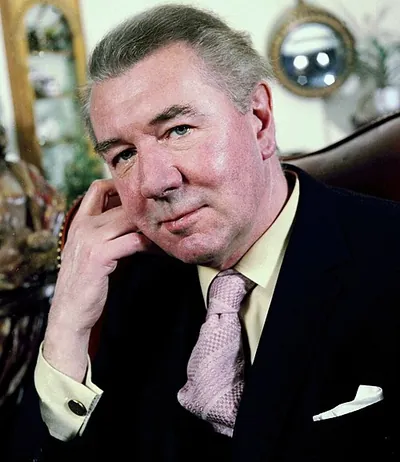
Michael Redgrave
1908–1985 · British actor of stage and screen, also director and writer
Biography
Sir Michael Redgrave (Bristol, 1908 – London, 1985) was an English actor, and also a director and writer. Together with John Gielgud, Laurence Olivier and Ralph Richardson, he formed part of the group of actors who dominated the British stage in the mid-twentieth century. His film debut came in Alfred Hitchcock's The Lady Vanishes (1938), and his Academy Award nomination for Mourning Becomes Electra (1947) and his Cannes prize for The Browning Version (1951) placed him among the most respected British performers of his generation.
He was the son of Roy Redgrave, a silent film actor who left the family when Michael was six months old, and of the actress Margaret Scudamore. He grew up with his mother and a stepfather he never warmed to. He studied at Clifton College and at Magdalene College, Cambridge, where he was a notable figure on the university stage and co-edited an avant-garde literary magazine. After teaching modern languages at Cranleigh School, he turned professional in 1934 at the Liverpool Playhouse. There he met Rachel Kempson, whom he married in 1935 and with whom he shared the stage for decades.
In 1936 he joined the Old Vic in London, playing Orlando in As You Like It and Laertes opposite Olivier's Hamlet. His stage work continued with John Gielgud's company and, during the war, with productions he directed himself. After the conflict he returned to major Shakespearean roles, playing Hamlet at Elsinore and, at Stratford-upon-Avon, Prospero, Shylock and King Lear. His Broadway work, including Hector in Tiger at the Gates and the title role of The Sleeping Prince, brought him recognition in New York.
His screen career was intermittent and always alongside the theatre. Redgrave appeared in Hitchcock thrillers such as Secret Agent (1936) and, in later decades, worked with directors including Orson Welles in Mr. Arkadin (1955), Michael Anderson in The Dam Busters (1955) and Jack Clayton in The Innocents (1961). His 1960s roles included The Hill (1965), The Heroes of Telemark (1965) and Battle of Britain (1969). His performance in The Browning Version earned him the Cannes prize, and his role in Nineteen Eighty-Four (1956) is remembered for its restraint.
In the second half of his life he combined the theatre with television and with opera direction at Glyndebourne. He is remembered mainly for his work at Stratford and the Old Vic, and for a family of actors that includes his children Vanessa, Corin and Lynn Redgrave. He was appointed a Commander of the Order of the British Empire in 1952 and knighted in 1959. He died in London in 1985, a day after his 77th birthday.
Key films
- The Lady Vanishes (1938), by Alfred Hitchcock: his film debut.
- Secret Agent (1936), by Alfred Hitchcock: one of his early films.
- Mr. Arkadin (1955), by Orson Welles: a role in Welles's cinema.
- The Innocents (1961), by Jack Clayton: a psychological suspense drama.
- The Browning Version (1951), by Anthony Asquith: his award-winning role at Cannes.
- Battle of Britain (1969), by Guy Hamilton: a role in the war film genre.
On Cinematopedia
 Nicholas and Alexandra1971
 The Go-Between1971
 The Lady Vanishes1938
 Battle of Britain1969
 The Innocents1961
 Goodbye, Mr. Chips1969
 Secret Agent1936
 The Hill1965
 Mr. Arkadin1955
 19841956
 The Loneliness of the Long Distance Runner1962
 The Heroes of Telemark1965
- Secret Agent 1936 · cast
- The Lady Vanishes 1938 · cast
- The Stars Look Down 1940 · cast
- The Big Blockade 1942 · cast
- Dead of Night 1945 · cast
- The Way to the Stars 1945 · cast
- The Captive Heart 1946 · cast
- Secret Beyond the Door 1947 · cast
- Mourning Becomes Electra 1947 · cast
- The Man Within 1947 · cast
- The Browning Version 1951 · cast
- The Importance of Being Earnest 1952 · cast
- Mr. Arkadin 1955 · cast
- The Dam Busters 1955 · cast
- Oh... Rosalinda!! 1955 · cast
- 1984 1956 · cast
- Time Without Pity 1957 · cast
- The Quiet American 1958 · cast
- Law and Disorder 1958 · cast
- The Wreck of the Mary Deare 1959 · cast
- The Innocents 1961 · cast
- The Loneliness of the Long Distance Runner 1962 · cast
- The Hill 1965 · cast
- The Heroes of Telemark 1965 · cast
- Young Cassidy 1965 · cast
- The 25th Hour 1967 · cast
- Assignment K 1968 · cast
- Battle of Britain 1969 · cast
- Goodbye, Mr. Chips 1969 · cast
- Oh! What a Lovely War 1969 · cast
- David Copperfield 1969 · cast
- Connecting Rooms 1970 · cast
- Nicholas and Alexandra 1971 · cast
- The Go-Between 1971 · cast
Original Cinematopedia text based on Wikipedia (es) and Wikipedia (en) and Wikidata.