
Marcel Achard
1899–1974 · French playwright and screenwriter
Biography
Marcel Achard, born Marcel-Auguste Ferréol (Sainte-Foy-lès-Lyon, 1899 - Paris, 1974), was a French playwright and screenwriter whose sentimental comedies kept him a widely recognized name in French theatrical and literary circles for five decades. His plays, often tinged with melancholy, made him one of the most popular dramatists of the interwar years, and several of his stories later reached the screen. He was elected to the Académie française in 1959.
Born in a suburb of Lyon, he moved to Paris in 1919 at the age of twenty and earned a living as a prompter at the Théâtre du Vieux-Colombier and as a journalist for several publications, including Le Figaro. Before settling on his pen name in the early 1920s, he had also tried acting on stage and, from 1923, in silent films. His breakthrough came with Voulez-vous jouer avec moâ?, staged by Charles Dullin, a comedy about a circus and its clowns in which the author himself took a small role. Its success opened other doors and set the tone for much of his later output.
Much of his theatre gives a modern twist to commedia dell'arte types such as Pierrot and Columbine, placing them in love stories where laughter sits beside pain and regret. Jean de la Lune (1929) and Domino (1932) follow this formula, and his titles often borrowed from popular songs, which added to their wistful air. His greatest popularity came between the wars. After the Second World War, critics faulted him for a rather narrow view of human psychology, although lesser-known plays such as La Belle Marinière (1929) show a more realistic approach.
His connection with cinema was steady. The first screen version of Jean de la Lune, directed by Jean Choux in 1931, adapted one of his plays, and he later worked on screenplays and adaptations for several filmmakers, including Jean Renoir. He directed a new version of Jean de la Lune himself in 1949, and his play L'Idiote became the basis for A Shot in the Dark (1964). From 1958 to 1959 he presided over the Cannes Film Festival.
He died in Paris in 1974, aged seventy-five, of diabetes-related complications. His legacy lives on in theatres and in the film versions of his work, and his blend of humour and melancholy remains a reference point for later playwrights and screenwriters.
Key films
- Jean de la Lune (1931), the first film adaptation of his work, directed by Jean Choux.
- Jean de la Lune (1949), a version he directed himself from his own play.
- Cocoanut (1939), based on his play Noix de coco, directed by Jean Boyer.
- A Shot in the Dark (1964), directed by Blake Edwards from his comedy L'Idiote.
- Patate (1964), directed by Robert Thomas from his play of the same name.
Trivia
A Broadway setback
His play Domino opened on Broadway in 1932 and closed after seven performances. Patate, years later, suffered a similar fate in New York.
A Broadway hit
The adaptation of L'Idiote, titled A Shot in the Dark, had the longest run of his plays on Broadway, with 389 performances in 1961 and 1962.
On Cinematopedia
 A Shot in the Dark1964
 The Merry Widow1934
 The Earrings of Madame de...1953
 Goodbye Again1961
 A Woman Like Satan1959
 Mayerling1936Gribouille1937Gribouille1937
 The Lady in Question1940
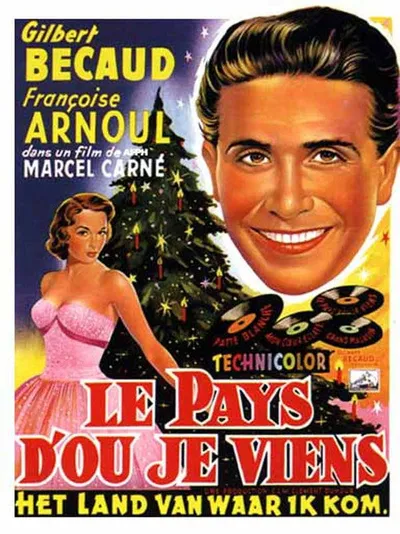 The Country I Come From1956
 Alibi1937The Heart of a Nation1943The Heart of a Nation1943Oh No, Mam'zelle1954Oh No, Mam'zelle1954
- Mistigri 1931 · screenplay
- The Beautiful Sailor 1932 · screenplay
- The Merry Widow 1934 · screenplay
- Mayerling 1936 · screenplay
- Gribouille 1937 · screenplay
- Alibi 1937 · screenplay
- The Messenger 1937 · screenplay
- The Kiss of Fire 1937 · screenplay
- The Strange Monsieur Victor 1938 · screenplay
- Orage 1938 · screenplay
- The Lady in Question 1940 · screenplay
- Monsieur La Souris 1942 · screenplay
- The Heart of a Nation 1943 · screenplay
- Two Timid Souls 1943 · director, screenplay
- The Little Ones of the Flower Platform 1944 · screenplay
- Pétrus 1946 · screenplay
- The Paris Waltz 1950 · director, screenplay
- The Earrings of Madame de... 1953 · screenplay
- Oh No, Mam'zelle 1954 · screenplay
- The Country I Come From 1956 · screenplay
- A Woman Like Satan 1959 · screenplay
- Goodbye Again 1961 · cast
- A Shot in the Dark 1964 · screenplay
- Cherchez l'idole 1964 · cast
Original Cinematopedia text based on Wikipedia (es) and Wikipedia (en) and Wikidata.