
John Cassavetes
1929–1989 · American actor, screenwriter and director, a pioneer of independent cinema
Biography
John Cassavetes (New York, 1929 – Los Angeles, 1989) was an American actor, screenwriter and director, regarded as a pioneer and one of the central figures of American independent film. He began his career as an actor in films and on television, but became best known as a filmmaker who wrote, directed, produced and distributed his own work, often with his own money. His working method, which was studied in many publications, was widely imitated later.
Born to a Greek-American family, he trained at the American Academy of Dramatic Arts in the early 1950s, in a milieu shaped by the Actors Studio and the teachings of Lee Strasberg. After touring and a stint on Broadway, he married the actress Gena Rowlands in 1954. She would become his muse and one of his main performers. His career first took shape in television, in the anthology drama series of the so-called Golden Age, before he returned to the stage. His first notable film roles came in 1956 and 1957, including Edge of the City, opposite Sidney Poitier.
His move into directing came with Shadows (1959), made with little-known actors, on natural locations and with funds raised partly from friends and from listeners of a radio show. It grew out of improvisation. He let the actors move without floor marks and refused to offer a conventional dramatic ending. The film took time to find an audience, and Cassavetes reworked it, which brought him international attention, especially in Europe. To finance his independent projects he accepted studio and television work, and he directed several episodes of the series Johnny Staccato.
During the following decade he focused on dramas about marriage, relationships and everyday tension, often shot in his own home with a circle of regular actors. Husbands (1970) and A Woman Under the Influence (1974) earned him critical prestige, and the latter brought an Oscar nomination for Best Director. Gloria (1980) won the Golden Lion at Venice. As an actor, his role in The Dirty Dozen, which earned him an Oscar nomination for Best Supporting Actor, and in Rosemary's Baby brought him wider recognition beyond independent cinema.
Cassavetes died in Los Angeles in 1989. His influence can be seen in later filmmakers who pursued low-budget productions and spontaneous performances. His children Nick, Alexandra and Zoe also built careers in film, and his work remains a reference point for American independent cinema.
Key films
- Shadows (1959): his first film as a director, a portrait of young New Yorkers that marked the start of American independent cinema.
- Husbands (1970): a drama about male friendship after the death of a friend, built on improvisation and close framing.
- A Woman Under the Influence (1974): a portrait of a woman who unravels in front of her family, nominated for the Academy Award for Best Director.
- Opening Night (1977): a stage actress confronts her own crisis during the opening of a play.
- Gloria (1980): an action film about a woman who protects a boy, winner of the Golden Lion in Venice.
Trivia
A prank at the Actors Studio
During an audition, Cassavetes and his friend Burt Lane improvised a scene while pretending to perform a known one. Strasberg reportedly was impressed, and Cassavetes later turned down the scholarship he was offered.
Shadows in Venice
Although Cassavetes could not secure American distribution for Shadows, the film won the Critics Award at the Venice Film Festival. European distributors later released it in the United States as an import.
On Cinematopedia
 Rosemary's Baby1968
 The Dirty Dozen1967
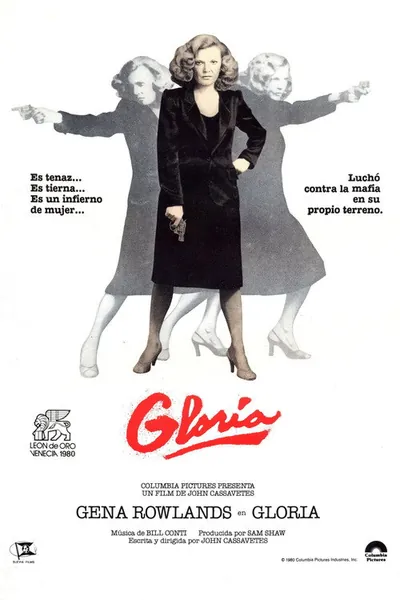 Gloria1980
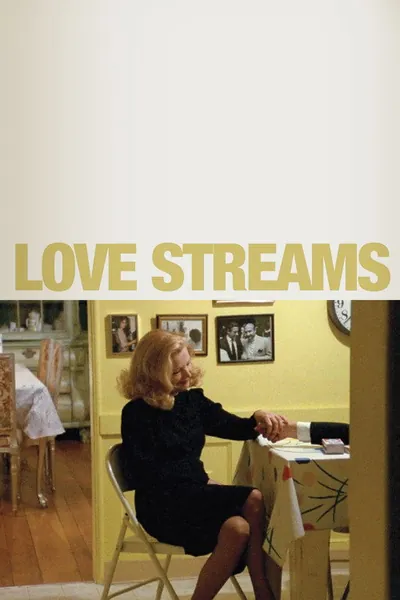 Love Streams1984
 A Woman Under the Influence1974
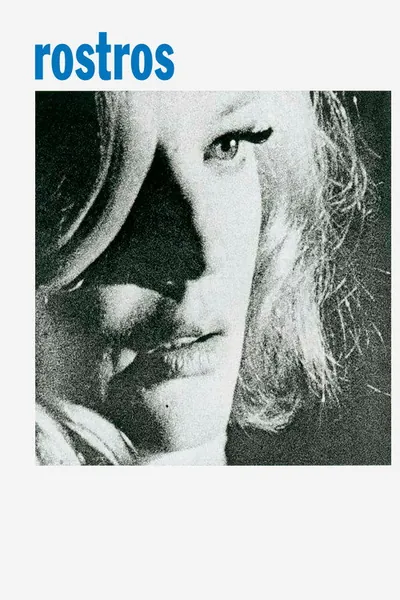 Faces1968
 The Killers1964
 Shadows1958
 Husbands1970
 Opening Night1977
 Capone1975
 Whose Life Is It Anyway?1981
- Crime in the Streets 1956 · cast
- Edge of the City 1957 · cast
- Affair in Havana 1957 · cast
- Shadows 1958 · director, screenplay, editing
- Virgin Island 1959 · cast
- A Child Is Waiting 1963 · director
- The Killers 1964 · cast
- The Dirty Dozen 1967 · cast
- Rosemary's Baby 1968 · cast
- Faces 1968 · director, screenplay, producer
- If It's Tuesday, This Must Be Belgium 1969 · cast
- Machine Gun McCain 1969 · cast
- Husbands 1970 · director, screenplay, editing, cast
- Minnie and Moskowitz 1971 · director, screenplay
- A Woman Under the Influence 1974 · director, screenplay
- Capone 1975 · cast
- The Killing of a Chinese Bookie 1976 · director, screenplay
- Two-Minute Warning 1976 · cast
- Mikey and Nicky 1976 · cast
- Opening Night 1977 · director, screenplay, cast
- The Fury 1978 · cast
- Brass Target 1978 · cast
- Gloria 1980 · director, screenplay
- Whose Life Is It Anyway? 1981 · cast
- The Incubus 1982 · cast
- Love Streams 1984 · director, screenplay, cast
- Big Trouble 1986 · director
- She's So Lovely 1997 · screenplay
- Gloria 1999 · screenplay
Original Cinematopedia text based on Wikipedia (es) and Wikipedia (en) and Wikidata.