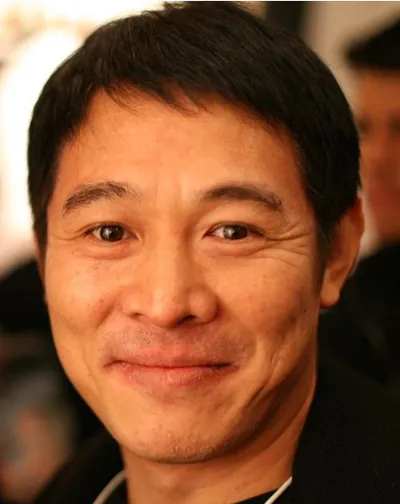
Jet Li
b. 1963 · Chinese martial artist, actor and producer, naturalised Singaporean
Biography
Li Lianjie, known as Jet Li, was born in Beijing in 1963 and is one of the most recognised figures in Asian action cinema. A martial artist, actor and producer who became a Singaporean citizen in 2009, he has built a career spanning more than four decades. His importance lies in bringing wushu, the Shaolin Temple and the wuxia tradition to audiences worldwide, from Hong Kong to Hollywood.
His childhood was shaped by hardship after his father died when he was only two, leaving the family in poverty. At eight he was spotted during a school summer course and began training with the Beijing wushu team under coaches Li Junfeng and Wu Bin. At eleven he became national champion in 1974, and he won the title several more times before retiring from competition in 1979 without ever being beaten. He studied a range of styles, including changquan and fanziquan, as well as many traditional weapons.
His film debut came with Shaolin Temple (1982), a box-office hit in China that spawned sequels. He then became a leading star of Hong Kong cinema through the Once Upon a Time in China series, directed by Tsui Hark, in which he played the folk hero Wong Fei-hung. In the mid-1990s he reshaped his image with gun-fu action films such as Black Mask. His move to Hollywood began with a villain role in Lethal Weapon 4 (1998), and his first leading part in an American studio production, Romeo Must Die (2000), brought him wider international attention. His screen style rests on speed and precision, and his fast strikes often required careful editing to be shown clearly.
In the 2000s he returned to Asian cinema with Hero (2002), directed by Zhang Yimou, and with Fearless (2006), a film he has often described as close to his own convictions. His presence in The Expendables (2010) introduced him to a new generation of Western viewers. Beyond the screen he has been active as a philanthropist: he has served as a philanthropic ambassador for the Red Cross Society of China since 2006 and in 2010 was named the first Goodwill Ambassador of the International Red Cross. He follows Tibetan Buddhism, and in 2013 he disclosed that he had been living with hyperthyroidism, which he said was managed with medication.
His legacy lies in presenting wushu as a serious performing art and in linking the cinemas of China, Hong Kong and Hollywood. After a period of very intense work, he has taken on fewer projects and devoted more time to charitable causes and personal wellbeing. He remains a reference point for action cinema and for audiences who see martial arts as a personal discipline rather than only a competitive sport.
Key films
- Once Upon a Time in China (1991): he plays Wong Fei-hung, the folk hero who defined his image as an Asian star.
- Lethal Weapon 4 (1998): his first Hollywood role, a villain that opened the door to the American market.
- Romeo Must Die (2000): his first leading role in a major American production, which brought him international recognition.
- Hero (2002): directed by Zhang Yimou, it is one of his best-known contemporary wuxia films and earned an Academy Award nomination.
- Fearless (2006): a martial arts drama in which he reflects on pride and humility.
- The Expendables (2010): the first instalment of the ensemble action franchise that brought together several major action names.
Trivia
An answer to Nixon
According to Li himself, as a child he was part of the Chinese wushu team that performed for President Richard Nixon in the United States, and Nixon asked him to serve as his personal bodyguard. Li replied that he did not want to protect one individual, but to defend his billion compatriots.
A name chosen by a publicity firm
His screen name originated in the Philippines in 1982, when a publicity company judged his real name too hard to pronounce. They linked him to the aircraft, which also takes off quickly, and the name Jet Li stuck.
On Cinematopedia
 The Expendables2010
 The Mummy: Tomb of the Dragon Emperor2008
 The Expendables 22012
 Mulan2020
 Hero2002
 The Expendables 32014
 Lethal Weapon 41998
 The Forbidden Kingdom2008
 Romeo Must Die2000
 The One2001
 Fearless2006
 War2007
- Shaolin Temple 1982 · cast
- Kids From Shaolin 1984 · cast
- Born to Defence 1986 · director, cast
- Martial Arts of Shaolin 1986 · cast
- The Master 1989 · cast
- Dragon Fight 1989 · cast
- Once Upon a Time in China 1991 · cast
- Once Upon a Time in China II 1992 · cast
- Swordsman II 1992 · cast
- Fong Sai-yuk 1993 · producer, cast
- Once Upon a Time in China III 1993 · cast
- The Legend II 1993 · producer, cast
- Last Hero in China 1993 · producer, cast
- Kung Fu Cult Master 1993 · producer, cast
- Fist of Legend 1994 · producer, cast
- The Bodyguard from Beijing 1994 · producer, cast
- The New Legend of Shaolin 1994 · producer, cast
- My Father Is a Hero 1995 · cast
- High Risk 1995 · cast
- Black Mask 1996 · cast
- Tai Chi Master 1996 · producer, cast
- Dr. Wai in "The Scripture with No Words" 1996 · cast
- Once Upon a Time in China and America 1997 · cast
- Lethal Weapon 4 1998 · cast
- Hitman 1998 · cast
- Romeo Must Die 2000 · cast
- The One 2001 · cast
- Kiss of the Dragon 2001 · cast
- Hero 2002 · cast
- Ballistic: Ecks vs. Sever 2002 · cast
- Cradle 2 the Grave 2003 · cast
- Unleashed 2005 · producer, cast
- Fearless 2006 · producer, cast
- War 2007 · cast
- The Warlords 2007 · cast
- The Mummy: Tomb of the Dragon Emperor 2008 · cast
- The Forbidden Kingdom 2008 · cast
- The Founding of a Republic 2009 · cast
- The Expendables 2010 · cast
- Ocean Heaven 2010 · cast
- Flying Swords of Dragon Gate 2011 · cast
- The Sorcerer and the White Snake 2011 · cast
- The Expendables 2 2012 · cast
- Badges of Fury 2013 · cast
- The Expendables 3 2014 · cast
- League of Gods 2016 · cast
- Mulan 2020 · cast
Original Cinematopedia text based on Wikipedia (es) and Wikipedia (en) and Wikidata.