
James Cagney
1899–1986 · American actor and dancer
Biography
James Francis Cagney Jr. (1899-1986) was an American actor and dancer, one of the most recognizable faces of Warner Bros. during Hollywood's Golden Age. He is best remembered for hard-edged tough guys, though his career also took in comedies, musicals, Westerns and dramas. In 1999 the American Film Institute placed him eighth on its list of the greatest male stars of that era, and Orson Welles called him maybe the greatest actor who ever stood in front of a camera.
He was born in 1899 on Manhattan's Lower East Side to a father of Irish descent who worked as a bartender and boxed as an amateur. His biographers disagree about the precise spot of his birth. His early years were spent in a string of jobs, including junior architect, copy boy, library custodian, bellhop, draughtsman and night doorkeeper, and he handed his wages to his family. After his father died in the 1918 flu pandemic, he left Columbia College after a single semester. He had been tap dancing since boyhood, a skill that later fed into his Oscar win, and he reached the final of New York State's amateur lightweight boxing title, though his mother would not let him turn professional. His path into acting was an accident: when his brother Harry fell ill during an amateur production, Cagney stepped in, relying on a near-photographic memory of the rehearsals.
He made his professional debut in 1919 in the chorus of Every Sailor, a wartime play in which servicemen performed in drag, and then spent a decade in vaudeville and on Broadway. In 1922 he married Frances Vernon, a fellow chorus member. After a failed attempt to find work in California in 1924, he returned east. Following four minor films, he broke through in The Public Enemy (1931), directed by William A. Wellman, part of the gangster cycle that Warner pushed at the time. That success made him one of the studio's leading stars, and through the 1930s he moved between urban dramas, quick-witted comedies and musicals such as Footlight Parade (1933), where his dancing background came into its own.
He earned his first Oscar nomination for Angels with Dirty Faces in 1938 and won the Academy Award for Yankee Doodle Dandy in 1942, playing a romanticized George M. Cohan. Shortly afterward he founded his own production company, which did not prosper, and he eventually returned to Warner. In the 1950s he worked on films including Love Me or Leave Me (1955), which brought him a third nomination. He retired in 1961 after One, Two, Three, Billy Wilder's comedy, and came back in 1981 for Ragtime, his last film. He died in 1986 in a New York hospital from pulmonary edema, after a heart attack the previous year.
His legacy includes a star on the Hollywood Walk of Fame, placed in 1960, and the American Film Institute's Life Achievement Award in 1974. Today he is remembered for energetic performances, a distinctive voice and a dry comic timing that set him apart from his contemporaries.
Key films
- The Public Enemy (1931): the role that made him a star and a landmark of the gangster film.
- Angels with Dirty Faces (1938): the charismatic gangster that earned his first Academy Award nomination.
- Yankee Doodle Dandy (1942): the George M. Cohan biography that won him the Oscar for Best Actor.
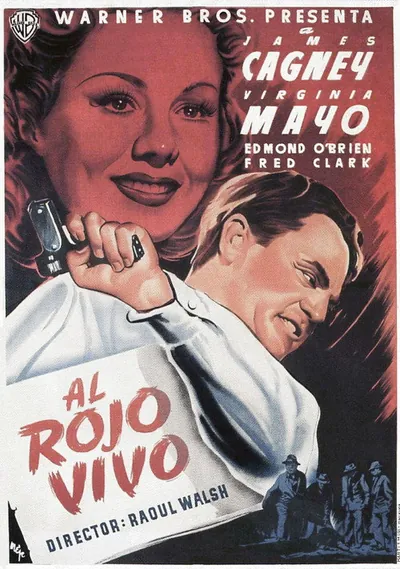
- White Heat (1949): the violent criminal of his famous final scene, with the line 'Made it, Ma! Top of the world!'
- Love Me or Leave Me (1955): a musical drama that gave him his third Oscar nomination.
- One, Two, Three (1961): Billy Wilder's comedy, which closed his acting career for two decades.
Trivia
A nickname from the street
His friends called him 'Cellar-Door Cagney' because he liked to dance on the slanted cellar doors of the city.
Twice walking away from Warner
He left Warner Bros. twice, returning each time on much better personal and artistic terms. Jack L. Warner nicknamed him 'the Professional Againster' for refusing to be pushed around.
On Cinematopedia
 Mutiny on the Bounty1935
 Yankee Doodle Dandy1942
 Mister Roberts1955
 The Public Enemy1931
 A Midsummer Night's Dream1935
 Angels with Dirty Faces1938
 One, Two, Three1961
 White Heat1949
 The Roaring Twenties1939
 Ragtime1981
 Love Me or Leave Me1955
 Here Comes the Navy1934
- The Doorway to Hell 1930 · cast
- The Public Enemy 1931 · cast
- Smart Money 1931 · cast
- Blonde Crazy 1931 · cast
- The Crowd Roars 1932 · cast
- Footlight Parade 1933 · cast
- Lady Killer 1933 · cast
- Here Comes the Navy 1934 · cast
- Jimmy the Gent 1934 · cast
- Mutiny on the Bounty 1935 · cast
- A Midsummer Night's Dream 1935 · cast
- G Men 1935 · cast
- Devil Dogs of the Air 1935 · cast
- Frisco Kid 1935 · cast
- The Irish in Us 1935 · cast
- Ceiling Zero 1936 · cast
- Great Guy 1936 · cast
- Something to Sing About 1937 · cast
- Angels with Dirty Faces 1938 · cast
- The Roaring Twenties 1939 · cast
- Each Dawn I Die 1939 · cast
- The Oklahoma Kid 1939 · cast
- City for Conquest 1940 · cast
- The Strawberry Blonde 1941 · cast
- The Bride Came C.O.D. 1941 · cast
- Yankee Doodle Dandy 1942 · cast
- Captains of the Clouds 1942 · cast
- Blood on the Sun 1945 · cast
- 13 Rue Madeleine 1947 · cast
- White Heat 1949 · cast
- Kiss Tomorrow Goodbye 1950 · cast
- Come Fill the Cup 1951 · cast
- What Price Glory 1952 · cast
- Mister Roberts 1955 · cast
- Love Me or Leave Me 1955 · cast
- Run for Cover 1955 · cast
- The Seven Little Foys 1955 · cast
- Tribute to a Bad Man 1956 · cast
- Man of a Thousand Faces 1957 · cast
- Shake Hands with the Devil 1959 · cast
- One, Two, Three 1961 · cast
- Ragtime 1981 · cast
- Dead Men Don't Wear Plaid 1982 · cast
Original Cinematopedia text based on Wikipedia (es) and Wikipedia (en) and Wikidata.