
Jacques Prévert
1900–1977 · French poet, playwright and screenwriter
Biography
Jacques Prévert (Neuilly-sur-Seine, 1900 - Omonville-la-Petite, 1977) was a French poet, playwright and screenwriter. He is best known to film audiences for his scripts of the poetic realist period of the 1930s and 1940s, but his verse, which is widely read and taught in French schools, has given him a reputation that reaches well beyond the cinema.
After serving in the First World War, Prévert settled back in Paris, and during the 1920s he became an active member of the Surrealist circle known as the rue du Château group, alongside Raymond Queneau and Marcel Duhamel. He stayed away from the more formal side of Surrealism, though he is credited with popularising playful practices such as the exquisite corpse. In 1928 he and his brother Pierre set up a theatre and film production company. In the 1930s he was the driving force behind the Groupe Octobre, an agitprop theatre company linked to the French Communist Party. His independent streak made him a suspect in some eyes, who linked him to Trotskyism, and he is generally associated with anarchism as well.
His film career was built largely on his partnership with Marcel Carné, for whom he wrote several screenplays that remain part of the French canon. Together they made Drôle de drame (1937), Port of Shadows (1938), Daybreak (1939), The Night Visitors (1942) and Children of Paradise (1945). Their dialogue, quick and often wry, sat alongside stories of love and fate set in working-class districts and harbour towns. Prévert also worked on L'Atalante (1934) and Monsieur Lange's Crime (1935), which show his interest in outsiders and his critical view of society.
He was also a prolific poet. His book Paroles (1946) was a great success and made him one of the most widely read writers in France. His style relies on sound play, alliteration, lists of unrelated objects, personified animals and neologisms, with a humour that moves between dark and erotic. He joined the Collège de Pataphysique, where he reached the rank of satrap in 1953. Several of his poems were set to music by Joseph Kosma and sung by performers including Yves Montand, Juliette Gréco and Édith Piaf, and 'Autumn Leaves' is probably the best known of them.
For decades he also worked with the animator Paul Grimault, co-writing short and feature animations and adapting tales by Hans Christian Andersen. Their last project, The King and the Mockingbird, was still in progress when Prévert died of lung cancer in 1977. The film was released in 1980 and dedicated to his memory. Today he is remembered in France as a poet with a broad readership and as a screenwriter of poetic, atmospheric cinema whose work is still studied and quoted.
Key films
- Children of Paradise (1945): screenplay for Marcel Carné, one of the most frequently cited films in French cinema, which earned Prévert an Oscar nomination for Best Original Screenplay.
- Daybreak (1939): script for Carné's romantic drama about a man trapped in a building, with a flashback structure still widely studied.
- Port of Shadows (1938): screenplay for a tragic love story set in a foggy harbour town, a key example of poetic realism.
- The Night Visitors (1942): script for Carné's medieval fable of love and betrayal, shot during the German occupation.
- L'Atalante (1934): screenplay for Jean Vigo's feature debut, a portrait of life aboard a river barge.
Trivia
An empty seat
At the opening night of The King and the Mockingbird in 1980, Paul Grimault kept the seat beside him empty in memory of Prévert.
Autumn Leaves
His poem Les feuilles mortes was sung by Yves Montand, and in 1961 Serge Gainsbourg paid tribute to it in his own song.
On Cinematopedia
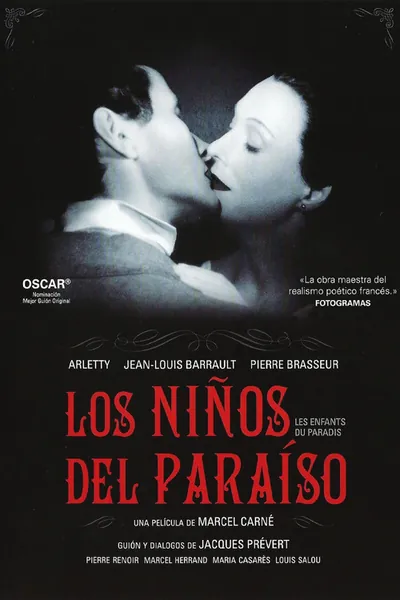 Children of Paradise1945
 L'Atalante1934
 Port of Shadows1938
 Daybreak1939
 The Hunchback of Notre Dame1956
 The Crime of Monsieur Lange1935
 Les Visiteurs du Soir1942
 Stormy Waters1941
 Bizarre, Bizarre1937Gates of the Night1946Gates of the Night1946
 Boys' School1938Lost Souvenirs1950Lost Souvenirs1950
- The Lovers of Midnight 1931 · cast
- It's in the Bag 1932 · screenplay, cast
- Ciboulette 1933 · screenplay, cast
- L'Atalante 1934 · cast
- The Crime of Monsieur Lange 1935 · screenplay
- Jenny 1936 · screenplay
- Bizarre, Bizarre 1937 · screenplay
- Port of Shadows 1938 · screenplay
- Boys' School 1938 · screenplay
- Ernest the Rebel 1938 · screenplay
- Baleydier 1938 · screenplay
- Daybreak 1939 · screenplay
- Stormy Waters 1941 · screenplay
- Les Visiteurs du Soir 1942 · screenplay, cast
- Summer Light 1943 · screenplay
- Children of Paradise 1945 · screenplay
- Gates of the Night 1946 · screenplay
- Lost Souvenirs 1950 · screenplay
- The Hunchback of Notre Dame 1956 · screenplay
Original Cinematopedia text based on Wikipedia (es) and Wikipedia (en) and Wikidata.