
Jacques Becker
1906–1960 · French film director and screenwriter
Biography
Jacques Becker (Paris, 15 September 1906 - Paris, 21 February 1960) was a French director and screenwriter whose films, mostly made in the 1940s and 1950s, ranged from urban comedy to film noir and prison drama. Admired by filmmakers who would later lead the New Wave, he is now valued for the consistency of his style and his rigour.
He came from an upper-middle-class Parisian family. His father ran a battery manufacturer and his mother managed a dressmaking workshop near Chanel's fashion house. Becker had little interest in business. At eighteen he travelled to New York, and on a transatlantic liner he met King Vidor, who offered him work, which he declined. Back in France he formed a friendship with Jean Renoir, with whom he shared a love of jazz, sports cars and cinema. During the 1930s he worked as Renoir's assistant on a series of films and sometimes appeared briefly in them, as in Grand Illusion.
His first attempt at directing, L'Or du Cristobal (1939), collapsed amid financing problems and the war. Becker was called up, taken prisoner and eventually repatriated. During the Occupation he made Dernier Atout (1942) and Goupi Mains Rouges (1943). After the war came a string of popular comedies about young Parisians, among them Antoine and Antoinette (1947), which won the Palme d'Or at Cannes. Casque d'or (1952), a Belle Epoque drama starring Simone Signoret, followed, and Touchez pas au grisbi (1954) revived Jean Gabin's career and helped define the French gangster film. Commercial assignments came next, and then Montparnasse 19 (1958), a melodrama about Modigliani that Max Ophuls had begun before his death.
His last film, The Hole (1960), based on a real prison escape of 1947, returned to his sober, rigorous style and brought some of the warmest praise of his career. Becker died of lung cancer shortly before it opened. His legacy rests on his attention to character, his direction of actors and his feel for period detail. Jean-Pierre Melville and Jean Renoir held him in high regard, and François Truffaut wrote often about him. He was married to the actress Françoise Fabian, and his son Jean Becker also became a director.
Key films
- Casque d'or (1952): Simone Signoret plays a courtesan in this portrait of Paris's underworld at the turn of the century.
- Touchez pas au grisbi (1954): Jean Gabin as an ageing gangster in a distinctly French take on the crime film.
- Goupi Mains Rouges (1943): a rural drama of greed and murder in a French farming community, made during the Occupation.
- Antoine and Antoinette (1947): a comedy about a young Paris couple that reflects everyday life after the Liberation.
- Montparnasse 19 (1958): a melodrama about the last years of the painter Modigliani, starring Gérard Philipe.
- The Hole (1960): his final film, a sober, almost documentary account of a prison escape and one of his most admired works.
Trivia
A cameo in Grand Illusion
Becker appears briefly in Renoir's film as an English officer held prisoner, who smashes his watch rather than let the Germans have it.
Retakes in Melville's studio
To re-shoot scenes for The Hole, he used Jean-Pierre Melville's studio and repeated many takes until he was satisfied.
On Cinematopedia
 The Grand Illusion1937
 The Human Beast1938
 Grisbi1954
 The Hole1960
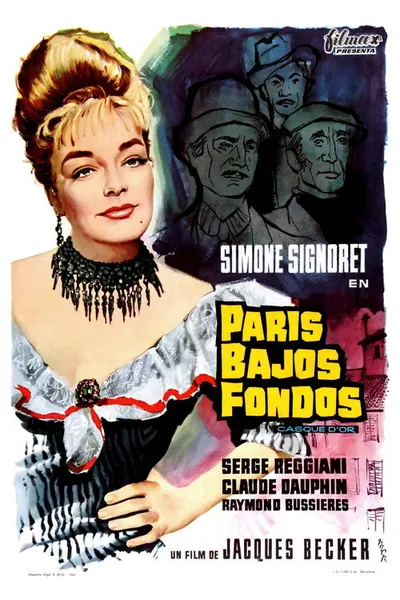 Casque d'Or1952
 Montparnasse 191958
 Boudu Saved from Drowning1932
 A Day in the Country1946
 Antoine and Antoinette1947
 The Lower Depths1936It Happened at the Inn1943It Happened at the Inn1943Rendezvous in July1949Rendezvous in July1949
- Le Bled 1929 · cast
- Boudu Saved from Drowning 1932 · cast
- Chotard and Company 1933 · cast
- The Lower Depths 1936 · cast
- Life Belongs to Us 1936 · director, screenplay, cast
- The Grand Illusion 1937 · cast
- The Human Beast 1938 · cast
- The Trump Card 1942 · director
- It Happened at the Inn 1943 · director
- Paris Frills 1945 · director
- A Day in the Country 1946 · cast
- Antoine and Antoinette 1947 · director, screenplay
- Rendezvous in July 1949 · director, screenplay
- Edward and Caroline 1951 · director
- Casque d'Or 1952 · director, screenplay
- Rue de l'Estrapade 1953 · director
- Grisbi 1954 · director, screenplay
- Ali Baba and the Forty Thieves 1954 · director, screenplay
- The Adventures of Arsène Lupin 1957 · director, screenplay, cast
- Montparnasse 19 1958 · director, screenplay
- The Hole 1960 · director, screenplay
Original Cinematopedia text based on Wikipedia (es) and Wikipedia (en) and Wikidata.