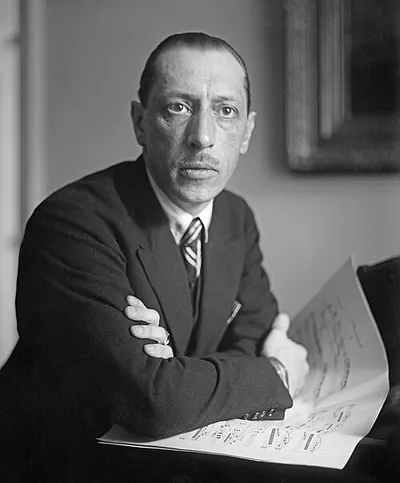
Igor Stravinsky
1882–1971 · Russian-born composer and conductor, naturalised American
Biography
Igor Stravinsky (Oranienbaum, 1882 – New York, 1971) was a Russian composer and conductor who became a French citizen in 1934 and an American citizen in 1945. He is widely regarded as one of the most influential composers of the twentieth century and a central figure of musical modernism. His connection to film was secondary to his work in the concert hall and in ballet, but his name is linked to several films of the silent and sound eras, and his music reached the screen in highly visible ways.
Born into a musical family, he grew up in Saint Petersburg, where his father sang bass at the Mariinsky Theatre. He began studying law at the university, but in 1902 started learning composition with Nikolai Rimsky-Korsakov, who remained his teacher until Rimsky-Korsakov's death in 1908. Soon afterwards he met the impresario Sergei Diaghilev, who commissioned three ballets for the Ballets Russes in Paris: The Firebird (1910), Petrushka (1911) and The Rite of Spring (1913). The last of these, with its abrupt rhythms and harsh dissonance, caused a famous uproar at its premiere, with fights in the audience and police present during the second act.
His output is usually divided into three phases: Russian, neoclassical and serial. In the first, his ballets draw on folklore and Russian tradition. In the neoclassical phase he revived forms and themes from the classical repertory, as in the Octet (1923) or in Oedipus rex (1927), written with Jean Cocteau. He also worked with Pablo Picasso on Pulcinella (1920) and with George Balanchine on Apollon musagète (1928). In the serial phase he turned towards the twelve-tone method of Arnold Schoenberg, with works such as In Memoriam Dylan Thomas (1954). He was also a sought-after pianist and conductor, often performing his own music, and he left theoretical writings and conversations recorded with Robert Craft.
In his private life he married his cousin Yekaterina Nosenko in 1906, and they had children together. After meeting Vera de Bosset in the early 1920s, he lived a double life for years, until his first wife died in 1939. That same year he emigrated to the United States, escaping the war in Europe, and he took American citizenship in 1945. In his American years Robert Craft became his close collaborator, interpreter and chronicler, and he planned an opera with W. H. Auden. He died in New York in 1971 and was buried in Venice, near the grave of Diaghilev.
His legacy lies in the breadth of his work and in his ability to change style without losing a recognisable voice. Time magazine counted him among the most influential people of the twentieth century. A star on the Hollywood Walk of Fame also bears his name. His music remains part of the core orchestral and ballet repertoire and continues to be studied.
Key films
- Aelita (1924), a Soviet silent film listed among his notable film credits; the exact extent of his musical contribution is not well documented.
- The Truth (1960), a drama directed by Henri-Georges Clouzot and starring Brigitte Bardot; it appears among his notable film credits, though his musical link to the film is doubtful.
- Fantasia (1940), in which The Rite of Spring becomes an animated Disney sequence, one of the routes by which his music reached a mass audience.
Trivia
A premiere with a scandal
The Paris premiere of The Rite of Spring in 1913 ended in fights among the audience and needed police presence during the second act.
A score returned
In 1908 he sent Rimsky-Korsakov the score of Feu d'artifice. It came back with a note stating that the addressee had died.
A star in Hollywood
A star on the Hollywood Walk of Fame, at 6340 Hollywood Boulevard, bears his name.
On Cinematopedia
 Aelita
 The Truth
 La Belle Noiseuse
Original Cinematopedia text based on Wikipedia (es) and Wikipedia (en) and Wikidata.