
Hideko Takamine
1924–2010 · Japanese actress
Biography
Hideko Takamine (Hakodate, 1924 - Tokyo, 2010) was one of the most celebrated actresses of postwar Japanese cinema. She started as a child performer and sustained a career of around fifty years, becoming the country's leading female star during the 1950s.
Born in Hakodate on Hokkaido, she was placed in the care of an aunt in Tokyo after her mother died when she was four. Her debut in Mother (1929) for Shochiku made her a popular child actress, and many of her early films followed the template of Shirley Temple's pictures. After moving to Toho in 1937, her dramatic work in Horse brought her wider recognition as a leading lady. During the war she toured as a singer for the troops, and in 1947 she joined the breakaway union group that helped form the Shintoho studio. She became a freelance actress in 1950.
Her partnerships with Keisuke Kinoshita and, above all, Mikio Naruse defined her standing. Naruse cast her as lead in seventeen of his films between 1941 and 1966, and her sensitive yet resilient heroines spoke to the dissatisfaction felt by many women of the period. She married the writer-director Zenzo Matsuyama in 1955 but kept working. She retired in 1979, then published an autobiography and several essay collections. She died of lung cancer in 2010 at the age of 86, and her name remains tied to the working woman in Japanese film.
Key films
- Mother (1929): her breakthrough as a child performer.
- Twenty-Four Eyes (1954): Keisuke Kinoshita's antiwar drama, which made her one of the country's leading stars.
- Floating Clouds (1955): Mikio Naruse's critically admired film and one of her best-known performances.
- When a Woman Ascends the Stairs (1960): Naruse's portrait of a bar hostess, a key example of their work together.
- Carmen Comes Home (1951): Kinoshita's satirical comedy and Japan's first feature-length colour film.
Trivia
First child role
Her debut in Mother (1929) made her a popular child actress, and many of her early films imitated Shirley Temple's pictures.
Union and Shintoho
During the postwar Toho strikes she joined a new union with nine other major stars, a group that went on to form the Shintoho studio in 1947.
On Cinematopedia
 Rickshaw Man1958
 Those Who Make Tomorrow1946
 Floating Clouds1955
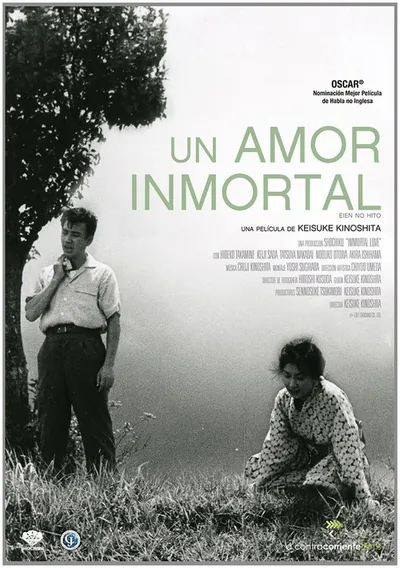 Immortal Love1961
 Tokyo Chorus1931
 The Munekata Sisters1950
 Twenty-Four Eyes1954Carmen Comes Home1951Carmen Comes Home1951
 Lightning1952
 Untamed1957
 When a Woman Ascends the Stairs1960Where Chimneys Are Seen1953Where Chimneys Are Seen1953
- Tokyo Chorus 1931 · cast
- Horse 1940 · cast
- Hideko the Bus Conductor 1941 · cast
- The Opium War 1943 · cast
- Those Who Make Tomorrow 1946 · cast
- The Munekata Sisters 1950 · cast
- Carmen Comes Home 1951 · cast
- Lightning 1952 · cast
- Where Chimneys Are Seen 1953 · cast
- The Wild Geese 1953 · cast
- Twenty-Four Eyes 1954 · cast
- The Garden of Women 1954 · cast
- Floating Clouds 1955 · cast
- A Wife's Heart 1956 · cast
- Flowing 1956 · cast
- Untamed 1957 · cast
- Times of Joy and Sorrow 1957 · cast
- Rickshaw Man 1958 · cast
- When a Woman Ascends the Stairs 1960 · cast
- Daughters, Wives and a Mother 1960 · cast
- The River Fuefuki 1960 · cast
- Immortal Love 1961 · cast
- A Wanderer's Notebook 1962 · cast
- Yearning 1964 · cast
Original Cinematopedia text based on Wikipedia (es) and Wikipedia (en) and Wikidata.