
Frank Sinatra
1915–1998 · American singer and actor
Biography
Francis Albert Sinatra, known as Frank Sinatra (Hoboken, New Jersey, 1915 – Los Angeles, California, 1998), was an American singer and actor and one of the most influential entertainers of the twentieth century. His musical career began in the swing era and grew through radio and records. On screen he moved between dramatic roles, musicals, action films and, later in his career, detective stories. His importance rests on both his voice and a screen presence that drew on his charisma and instinct.
The only child of Italian immigrants, he grew up in a middle-class neighborhood of Hoboken. His mother, Dolly, was an active figure in local Democratic Party circles, while his father, a bantamweight boxer who later joined the fire department, hoped he would study engineering. Sinatra showed little interest in school and left A. J. Demarest High School in 1931 without graduating. He held a range of jobs, from newspaper delivery to riveting at a shipyard, while singing at social clubs and on local radio stations. His model was Bing Crosby, whose style he initially tried to imitate before developing his own.
In 1935 he joined a vocal group that became the Hoboken Four and won the Major Bowes Amateur Hour radio contest, which led to a tour. In 1939 he became the vocalist with Harry James's band and soon after joined Tommy Dorsey's orchestra, where he stayed for years. Dorsey was a decisive influence: Sinatra adopted his demanding, perfectionist approach and learned to shape phrases and manage breath with care. One defining feature of his style was the deliberate use of the microphone to place his voice above the orchestra and bring it close to the listener's ear, a practice that set him apart from most singers of his generation.
As an actor he was intuitive and reluctant to rehearse, so his performances were intense but uneven. His role in From Here to Eternity (1953) earned him the Academy Award for Best Supporting Actor and restored a popularity that had faded. He then starred in The Man with the Golden Arm (1955), High Society (1956) and Pal Joey (1957), which brought him a Golden Globe, and had a notable part in The Manchurian Candidate (1962). Late in his career he played several detectives and directed the anti-war drama None but the Brave (1965).
Beyond film, Sinatra recorded more than thirteen hundred songs and worked with leading arrangers and musicians, among them Nelson Riddle, Count Basie, Duke Ellington and Antonio Carlos Jobim. In 1960 he founded his own record label, Reprise Records. Television also mattered to him, and The Frank Sinatra Show began on CBS in 1950. He received several Grammy Awards, the Presidential Medal of Freedom in 1985 and the Congressional Gold Medal in 1997.
Sinatra died in Los Angeles in 1998, but his image remains a point of reference. He has three stars on the Hollywood Walk of Fame, and the critic Robert Christgau called him the greatest singer of the twentieth century. His record sales are estimated at around 150 million worldwide. His legacy combines a highly recognizable vocal style with films still studied as examples of the shift from classical Hollywood to a newer kind of cinema.
Key films
- From Here to Eternity (1953), a supporting role that earned him the Oscar and revived his career
- The Man with the Golden Arm (1955), a drama about addiction in which he showed a harder edge
- High Society (1956), a musical opposite Grace Kelly and Bing Crosby
- Pal Joey (1957), a musical comedy that won him a Golden Globe
- The Manchurian Candidate (1962), a political thriller with one of his most admired performances
Trivia
An unexpected Oscar
His performance in From Here to Eternity won him the Academy Award for Best Supporting Actor, arriving just as his career was recovering.
A radio contest win
The vocal group he sang with won the Major Bowes Amateur Hour contest, and the prize included a tour across the United States.
An anecdote about Carlos Gardel
It is said that Carlos Gardel urged him to leave bad company and devote himself to music, although the story has several versions and cannot be verified.
On Cinematopedia
 From Here to Eternity1953
 Around the World in 80 Days1956
 The Manchurian Candidate1962
 Anchors Aweigh1945
 Ocean's Eleven1960
 On the Town1949
 Pal Joey1957
 Some Came Running1958
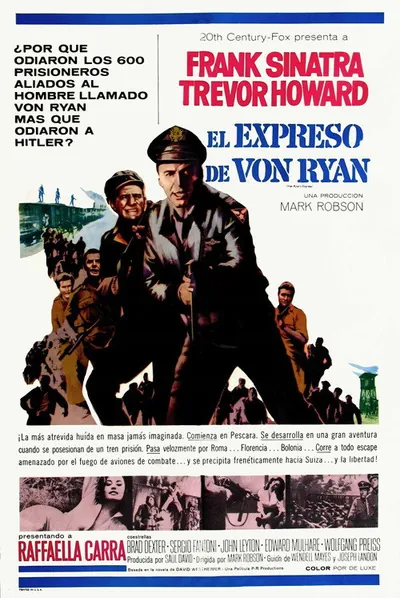 Von Ryan's Express1965
 Cast a Giant Shadow1966
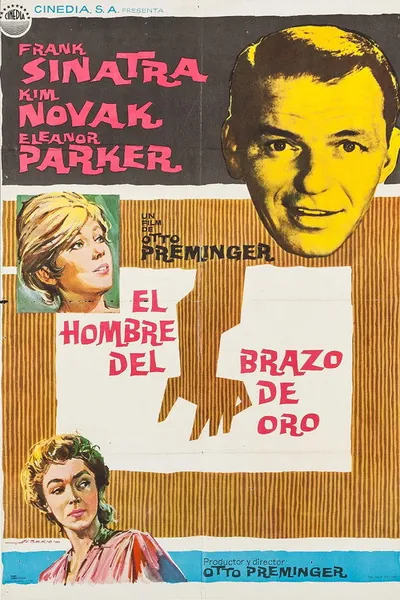 The Man with the Golden Arm1955
 Paris When It Sizzles1964
- Step Lively 1944 · cast
- Anchors Aweigh 1945 · cast
- Till the Clouds Roll By 1946 · cast
- The Miracle of the Bells 1948 · cast
- The Kissing Bandit 1948 · cast
- On the Town 1949 · cast
- Take Me Out to the Ball Game 1950 · cast
- Double Dynamite 1951 · cast
- From Here to Eternity 1953 · cast
- Suddenly 1954 · cast
- Young at Heart 1954 · cast
- The Man with the Golden Arm 1955 · cast
- Guys and Dolls 1955 · cast
- Not as a Stranger 1955 · cast
- The Tender Trap 1955 · cast
- Around the World in 80 Days 1956 · cast
- High Society 1956 · cast
- Pal Joey 1957 · cast
- The Pride and the Passion 1957 · cast
- The Joker Is Wild 1957 · cast
- Some Came Running 1958 · cast
- Kings Go Forth 1958 · cast
- A Hole in the Head 1959 · cast
- Never So Few 1959 · cast
- Ocean's Eleven 1960 · cast
- Pepe 1960 · cast
- Can-Can 1960 · cast
- The Devil at 4 O'Clock 1961 · cast
- The Manchurian Candidate 1962 · cast
- Advise & Consent 1962 · cast
- The Road to Hong Kong 1962 · cast
- Sergeants 3 1962 · producer, cast
- 4 for Texas 1963 · cast
- The List of Adrian Messenger 1963 · cast
- Paris When It Sizzles 1964 · cast
- Robin and the 7 Hoods 1964 · producer, cast
- Von Ryan's Express 1965 · cast
- Marriage on the Rocks 1965 · cast
- None But the Brave 1965 · director, cast
- Cast a Giant Shadow 1966 · cast
- Tony Rome 1967 · cast
- The Naked Runner 1967 · cast
- Lady in Cement 1968 · cast
- The Detective 1968 · cast
- That's Entertainment! 1974 · cast
- The First Deadly Sin 1980 · producer, cast
- Cannonball Run II 1984 · cast
Original Cinematopedia text based on Wikipedia (es) and Wikipedia (en) and Wikidata.