
Federico García Lorca
1898–1936 · Spanish poet, playwright and theatre director, a leading figure of the Generation of '27
Biography
Federico del Sagrado Corazón de Jesús García Lorca (Fuente Vaqueros, Granada, 1898 - Víznar, Granada, 1936) was a Spanish poet, prose writer, playwright and theatre director. He is regarded as the most influential and popular poet of Spanish literature of his time, and as one of the peaks of twentieth-century Spanish theatre. His direct link to film was limited, although his plays and poems have served as the basis for several adaptations, and his name appears in the credits of a few productions. His importance lies in how he brought European avant-garde ideas into a distinctly Andalusian poetic tradition.
He was born on 5 June 1898 in Fuente Vaqueros, a small town a few kilometres west of Granada, into a family of landowners. His mother, Vicenta Lorca, was a schoolteacher who encouraged his reading. In 1909 the family moved to Granada, where the young Federico studied piano with Antonio Segura Mesa. In his adolescence music attracted him more than literature, and his friendship with the composer Manuel de Falla turned his interest towards Andalusian folklore. After Segura's death in 1916 he began to write more seriously; his early prose pieces borrowed musical forms, and in 1918 he published Impresiones y paisajes.
In 1919 he moved into the Residencia de Estudiantes in Madrid, where he became friends with Luis Buñuel, Salvador Dalí and Juan Ramón Jiménez, among others of his generation. That year his first play, The Butterfly's Evil Spell, was staged; it failed with audiences after only four performances, and it is said to have made him wary of public reaction for the rest of his career. In 1921 he published Libro de poemas, with themes of faith, isolation and nature. His interest in music and drawing also shaped his approach to the stage, which he treated as a complete space rather than a vehicle for words alone.
His fame came with Gypsy Ballads (1928), a collection that recreated the Andalusia of his roots in a carefully stylised manner. After a stay in New York between 1929 and 1930, whose poetic fruit was published posthumously in 1942 as Poet in New York, he returned to Spain and wrote the plays for which he is best known: Blood Wedding (1932), Yerma (1934) and The House of Bernarda Alba (1936). In his private life García Lorca was homosexual; he had a relationship with the sculptor Emilio Aladrén and, for a time, a close emotional bond with Dalí, who according to his own account turned down the poet's advances. The gap between the public figure he felt obliged to maintain and his private life brought him increasing depression in his final years.
He was killed by Nationalist forces in August 1936, a few weeks after the coup that began the Spanish Civil War. His remains have never been found, and the motive for his death is still debated: some historians point to his homosexuality or his political views, others to a personal dispute. Today he is one of the most performed Spanish playwrights, at home and abroad. His plays have also reached the screen in later adaptations, such as Carlos Saura's 1981 version of Blood Wedding, which keeps his work present on film.
Key films
- Blood Wedding (1981), a screen version of his tragedy directed by Carlos Saura
- Sin límites (2008), a production in which he appears as a credited reference for the screenplay
- The House of Bernarda Alba (1987), an adaptation of his last major play directed by Mario Camus
Trivia
A failed debut
His first play, The Butterfly's Evil Spell, was taken off after only four performances because audiences disliked it.
Remains never found
His remains have never been located, so the circumstances of his death remain a subject of debate among historians.
On Cinematopedia
 Little Ashes
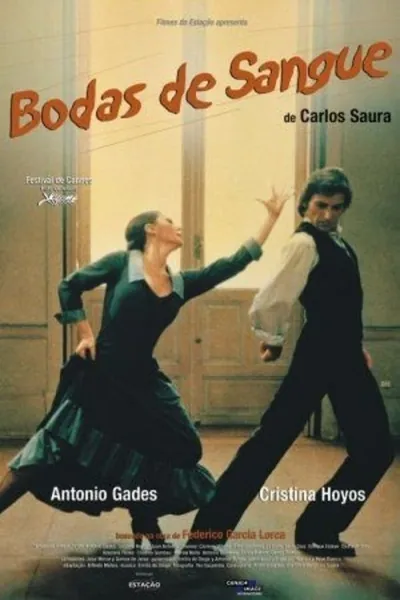 Blood Wedding
 The Bride
 The House of Bernarda Alba
Original Cinematopedia text based on Wikipedia (es) and Wikipedia (en) and Wikidata.