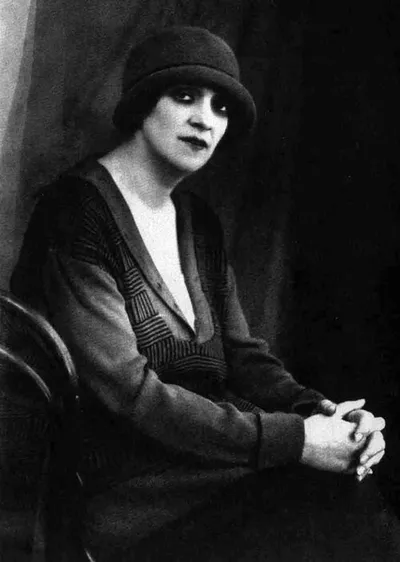
Faina Ranevskaya
1896–1984 · Soviet actress of stage and screen
Biography
Faina Ranevskaya (Taganrog, 1896 - Moscow, 1984) was a Soviet actress of stage and screen, best remembered for her comic roles, although she also worked in drama. Her name is tied to the Moscow theatre scene and to a highly recognisable style of acting, and her career spans almost the entire Soviet period. She is now regarded as one of the great performers of Russian theatre and cinema in the twentieth century.
Born into a wealthy Jewish family, under the surname Feldman, she trained in private theatre schools despite her family's opposition. In 1915 she moved to Moscow, where she met writers and poets such as Marina Tsvetaeva, Osip Mandelstam, Vladimir Mayakovsky and Anna Akhmatova. After the October Revolution her family emigrated, but she chose to remain in the Soviet Union and spent years touring provincial theatres in cities across the Caucasus, the north and Crimea, settling in Moscow only in the early 1920s. Her stage pseudonym came from Ranevskaya, the heroine of Chekhov's The Cherry Orchard, a play that had made a strong impression on her as a teenager at the Moscow Art Theatre.
On stage she worked with several Moscow companies: the Central Theatre of the Red Army, the Mayakovsky Theatre, the Pushkin Theatre and, above all, the Mossovet, where she worked with Yuri Zavadsky. Her repertoire included plays by Chekhov, Ostrovsky, Dostoevsky and Gorky. Only recordings of her last three productions survive.
In films she rarely had leading roles, and her parts were almost always supporting ones, yet her name on a poster was considered a guarantee of success. She made her screen debut in Pyshka (1934), directed by Mikhail Romm, an adaptation of Maupassant's Boule de Suif, in which she played Madame Loiseau. The film was shown in French cinemas at the request of the writer Romain Rolland and was well received. Later credits include Cinderella and Springtime (1947), and she continued to work in wartime and comic films such as Encounter at the Elbe (1949) and A Girl with a Guitar (1958).
She received two Stalin Prizes, in 1949 and 1951, and in 1961 she was named People's Artist of the USSR. She died in Moscow in 1984 and was buried at Donskoye Cemetery. A memorial plaque on her birth house in Taganrog, placed in 1986, and a monument unveiled there in 2008 commemorate her. Her witty, outspoken aphorisms made her famous well beyond the cinema, and in 1992 the British Who's Who reference work listed her among the top ten actors of the twentieth century.
Key films
- Boule de Suif (1934): her screen debut, as Madame Loiseau in the adaptation of Maupassant's story.
- Cinderella (1947): plays the stepmother of the heroine in the Soviet version of the fairy tale.
- Springtime (1947): one of her best-known appearances, as the housekeeper of a painter.
- Encounter at the Elbe (1949): a supporting part in a film about Soviet and American soldiers meeting at the end of the war.
- Engineer Kochin's Error (1939): an early role in a story about industrial sabotage.
Trivia
A name taken from Chekhov
Her stage name came from Ranevskaya, the heroine of The Cherry Orchard, a play she saw at the Moscow Art Theatre as a teenager.
A film admired by Romain Rolland
The French writer Romain Rolland particularly liked Pyshka, and at his request the film was shown in French cinemas.
An asteroid named after her
The asteroid (6821) Ranevskaya was named in her honour.
On Cinematopedia
 Springtime1947Encounter at the Elbe1949Encounter at the Elbe1949A Girl with Guitar1958A Girl with Guitar1958The Foundling1940The Foundling1940Private Aleksandr Matrosov1947Private Aleksandr Matrosov1947Boule de Suif1934Boule de Suif1934Heavenly Slug1946Heavenly Slug1946Dream1943Dream1943Be Careful, Grandma!1961Be Careful, Grandma!1961Man in a Shell1939Man in a Shell1939
 The Wedding1944
- Boule de Suif 1934 · cast
- The Ballad of Cossack Golota 1937 · cast
- Man in a Shell 1939 · cast
- Engineer Kochin's Error 1939 · cast
- The Foundling 1940 · cast
- The Beloved 1940 · cast
- Alexander Parkhomenko 1942 · cast
- Dream 1943 · cast
- The Wedding 1944 · cast
- Heavenly Slug 1946 · cast
- Cinderella 1947 · cast
- Springtime 1947 · cast
- Private Aleksandr Matrosov 1947 · cast
- Encounter at the Elbe 1949 · cast
- They Have a Motherland 1949 · cast
- A Girl with Guitar 1958 · cast
- Be Careful, Grandma! 1961 · cast
- An Easy Life 1964 · cast
Original Cinematopedia text based on Wikipedia (es) and Wikipedia (en) and Wikidata.