
Duke Ellington
1899–1974 · American pianist, composer and bandleader
Biography
Edward Kennedy "Duke" Ellington (Washington, D.C., 1899 - New York, 1974) was a pianist, composer and bandleader whose career spanned more than five decades. He is widely regarded as one of the central figures of jazz, although he preferred to place his music in the broader category of American music. His screen work was more modest: he appeared in several films and wrote music for others, as well as for stage musicals.
Born into a household of pianists, Ellington started lessons at seven, though baseball held his interest for a time. His childhood friends gave him the nickname "Duke" for his poised manners and immaculate dress. He listened closely to the ragtime and stride players who worked in Washington's pool halls, and he studied harmony with Henry Lee Grant and Oliver "Doc" Perry. In 1917 he formed his first group, The Duke's Serenaders, while working as a freelance sign painter. In the mid-1920s he settled in New York, where his engagements at the Cotton Club, in Harlem, brought him a national audience.
During the 1930s his orchestra toured Europe, and his reputation began to cross the Atlantic. Ellington became a master of the short piece designed to fit a three-minute 78 rpm record, and he often wrote with the particular voice of each soloist in mind. Working with players such as Johnny Hodges and Ben Webster, he built one of the most celebrated ensembles in jazz history, and several members stayed for decades. His output exceeds a thousand compositions, many written with collaborators. "Caravan", by Juan Tizol, which he recorded, gave the big band a Spanish colour.
From the early 1940s he worked closely with Billy Strayhorn, whom he described as his writing and arranging partner. Together they produced extended suites as well as many shorter pieces. After a quieter stretch, a performance at the Newport Jazz Festival in July 1956 sparked a major revival and led to new world tours.
Ellington also left a mark on film. In Otto Preminger's Anatomy of a Murder (1959), his music is woven into the film's mood. In Vincente Minnelli's Cabin in the Sky (1943), he appears on screen and contributes to the music. He died in New York in 1974, but his reputation kept growing. In 1999 he received a posthumous Pulitzer Prize special award for his music. His recorded legacy is among the largest in jazz, and it is still performed and studied.
Key films
- Anatomy of a Murder (1959): Ellington composed the score, and his music sets the tone of the film.
- Cabin in the Sky (1943): a musical in which he appears on screen and contributes to the music.
- Birth of the Blues (1941): a musical in which jazz and blues are central to the story.
Trivia
The origin of the nickname
Ellington credited his friend Edgar McEntree with the nickname "Duke", recalling that McEntree felt he needed a title to be worthy of his constant company.
A posthumous honour
In 1999, twenty-five years after his death, he was awarded a special Pulitzer Prize for his music, given posthumously.
On Cinematopedia
 Anatomy of a Murder
 Ådalen 31
 Cabin in the Sky
 Paris Blues
 Belle of the Nineties
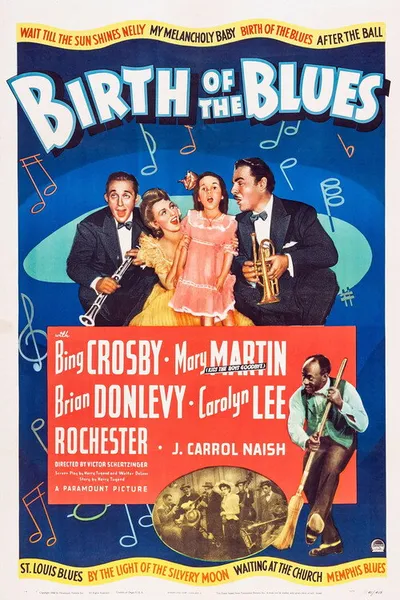 Birth of the Blues
Original Cinematopedia text based on Wikipedia (es) and Wikipedia (en) and Wikidata.