
Blake Edwards
1922–2010 · American director, screenwriter, producer and actor
Biography
Born William Blake Crump in Tulsa, Oklahoma, on July 26, 1922, and died in Santa Monica, California, on December 15, 2010, Blake Edwards was an American director, producer, screenwriter and actor. He is best remembered as the director of comedies, including the Pink Panther series, although he also made melodramas, musicals and detective films. Working across film, radio and television over roughly five decades, he became one of the few Hollywood filmmakers whose name alone could sell a picture.
Edwards grew up in a household shaped by the movies. His mother remarried, and her second husband, Jack McEdwards, became his stepfather and worked as a studio production manager. The family moved to Los Angeles in 1925. His stepgrandfather, J. Gordon Edwards, had directed silent films and worked closely with the Fox studio. After graduating from Beverly Hills High School in 1941, Edwards took acting jobs. He later said he had learned a great deal from directors such as John Ford, William Wyler and Otto Preminger, while admitting that as a young actor he was not especially cooperative. During the Second World War he served in the United States Coast Guard, where a serious back injury left him in pain for years.
His real calling, however, was writing, and he arrived at it almost by accident. A former girlfriend showed him a script she was preparing for a radio show, and Edwards ended up rewriting it entirely. Her boss was so impressed that he became his agent and found him steady work in radio. From there he moved into television, which served as both a training ground and a stepping stone toward the big screen. His bit parts in films of the period, sometimes uncredited, kept him close to the industry while he worked toward directing.
His first screenplay for the cinema was the 1948 western Imperio del crimen, directed by Lesley Selander, which he wrote with John Champion and co-produced. That same period marked the start of his partnership with Richard Quine, another young hopeful who had begun as an actor. Between 1952 and 1958 they wrote seven scripts together for Columbia Pictures, five of which Quine directed and two of which Edwards directed. Edwards's first feature as director was Venga tu sonrisa (1955). He had made his directing debut earlier, in 1952, on television, with the series Four Star Playhouse.
Television remained central to his development. He wrote the hard-boiled detective scripts for Richard Diamond, Private Detective, which NBC promoted as its answer to Sam Spade and Philip Marlowe. He then created, wrote and directed Peter Gunn (1958 to 1961), starring Craig Stevens, with a score by Henry Mancini. The following year he produced Mr. Lucky for CBS. Mancini's music became one of the defining elements of his films, most famously the song Moon River from Breakfast at Tiffany's.
His move into big-budget filmmaking came with Operation Petticoat (1959), starring Cary Grant and Tony Curtis, which became a major box-office hit for Universal and established him as a director worth hiring. Breakfast at Tiffany's (1961), based on Truman Capote's novella and starring Audrey Hepburn, cemented that reputation. Andrew Sarris called it the directorial surprise of 1961, and it became a romantic touchstone for college students in the early sixties. The following year brought Days of Wine and Roses (1962), a dark drama about alcoholism with Jack Lemmon and Lee Remick. It earned Edwards a Golden Globe nomination for best director and showed that he could work convincingly outside comedy. The same ambition runs through The Great Race (1965), a sprawling comedy with Tony Curtis, Jack Lemmon and Natalie Wood.
His most celebrated series was The Pink Panther, which began in 1963 with Peter Sellers as the bumbling Inspector Clouseau. Edwards directed most of the installments. In five of them he worked on original material with Sellers, including The Pink Panther (1963), A Shot in the Dark (1964), The Return of the Pink Panther (1975), The Pink Panther Strikes Again (1976) and Revenge of the Pink Panther (1978). Their partnership was productive and turbulent in equal measure, and Edwards later admitted that the moments when the two of them clicked were hard to resist. With Sellers he also explored the logic of silent comedy in The Party (1968), a film with very little dialogue that has since gained a devoted cult following. After Sellers died in 1980, Edwards made three more Pink Panther films, which were received with far less enthusiasm.
Not every project landed. Darling Lili (1970), starring Julie Andrews, was a costly failure that pushed Paramount close to financial trouble and became a byword for excess in the Hollywood of its day. Edwards bounced back with 10 (1979), with Dudley Moore and Bo Derek, and with Victor/Victoria (1982), with Andrews and James Garner. The latter is a remake of a German film from the early 1930s by Reinhold Schunzel, and it brought him his strongest recognition as a writer: a Writers Guild award, an Academy Award nomination for best adapted screenplay, and the David di Donatello for best foreign screenplay in Italy.
His personal life had several chapters. He married the actress Patricia Walker in 1953, and they had two children, Jennifer and Geoffrey Edwards. They divorced in 1967. In 1969 he married Julie Andrews, to whom he remained married until his death. He directed her in seven films. The couple adopted two Vietnamese girls. Edwards struggled for years with myalgic encephalomyelitis, commonly called chronic fatigue syndrome, which he described in the documentary I Remember Me (2000). After Son of the Pink Panther (1993), he stopped making films, and in later years he worked as an executive producer on television and returned to the stage.
His reputation remains divided. Some critics found his films glossy and shallow, while others saw real craft beneath the surface. In 1971 the British critic Peter Lloyd called him the finest director working in American commercial cinema, and his biographers William Luhr and Peter Lehman described him in similar terms. Today he is valued for his command of comic timing, his skill at blending farce with bitter material, and for creating one of the most loved franchises in film history. He received an Honorary Academy Award in 2004 for his body of work. He died at 88 from complications of pneumonia.
Key films
- Breakfast at Tiffany's (1961): romantic comedy with Audrey Hepburn that established Edwards as a director of prestige.
- Days of Wine and Roses (1962): drama about alcoholism with Jack Lemmon and Lee Remick, showing his more serious side.
- The Pink Panther (1963): the first film in the series, with Peter Sellers as Inspector Clouseau.
- The Great Race (1965): ensemble comedy with Tony Curtis, Jack Lemmon and Natalie Wood.
- The Party (1968): a near-silent comedy with Peter Sellers that has become a cult favorite.
Trivia
A script rewritten by accident
His entry into writing came when a former girlfriend showed him a radio script and he ended up rewriting it entirely. Her boss became his agent.
An Oscar with a joke attached
At the 2004 ceremony for his honorary Oscar, he made an entrance worthy of a Peter Sellers gag, and he told presenter Jim Carrey not to touch his statuette.
On Cinematopedia
 The Best Years of Our Lives1946
 Breakfast at Tiffany's1961
 The Pink Panther1963
 The Great Race1965
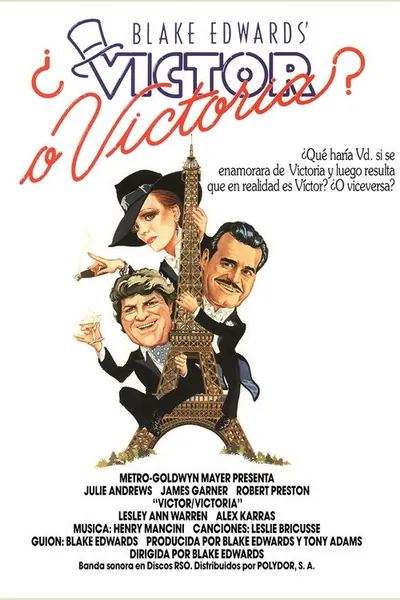 Victor/Victoria1982
 Days of Wine and Roses1962
 A Shot in the Dark1964
 The Return of the Pink Panther1975
 Blind Date1987
 101979
 The Party1968
 Operation Petticoat1959
- Ten Gentlemen from West Point 1942 · cast
- A Guy Named Joe 1943 · cast
- Wing and a Prayer 1944 · cast
- They Were Expendable 1945 · cast
- The Best Years of Our Lives 1946 · cast
- The Strange Love of Martha Ivers 1946 · cast
- Till the End of Time 1946 · cast
- The Beginning or the End 1947 · cast
- My Sister Eileen 1955 · screenplay
- Mister Cory 1957 · director, screenplay
- Operation Mad Ball 1957 · screenplay
- The Perfect Furlough 1958 · director
- Operation Petticoat 1959 · director
- This Happy Feeling 1959 · director, screenplay
- High Time 1960 · director
- Breakfast at Tiffany's 1961 · director
- Days of Wine and Roses 1962 · director
- Experiment in Terror 1962 · director, producer
- The Notorious Landlady 1962 · screenplay
- The Pink Panther 1963 · director, screenplay
- A Shot in the Dark 1964 · director, producer
- The Great Race 1965 · director
- What Did You Do in the War, Daddy? 1966 · director, producer
- Waterhole #3 1967 · producer
- The Party 1968 · director, screenplay, producer
- Inspector Clouseau 1968 · screenplay
- Darling Lili 1970 · director, screenplay, producer
- Wild Rovers 1971 · director, screenplay, producer
- The Carey Treatment 1972 · director
- The Tamarind Seed 1974 · director
- The Return of the Pink Panther 1975 · director, screenplay
- The Pink Panther Strikes Again 1976 · director, screenplay
- Revenge of the Pink Panther 1978 · director, screenplay, producer
- 10 1979 · director, screenplay, producer
- S.O.B. 1981 · director, screenplay
- Victor/Victoria 1982 · director, screenplay, producer
- Trail of the Pink Panther 1982 · director, screenplay, producer
- Curse of the Pink Panther 1983 · director, screenplay, producer
- City Heat 1984 · screenplay
- Micki & Maude 1984 · director
- That's Life! 1986 · director, screenplay
- A Fine Mess 1986 · director, screenplay
- Blind Date 1987 · director
- Sunset 1988 · director, screenplay
- Skin Deep 1989 · director, screenplay
- Switch 1991 · director, screenplay
- Son of the Pink Panther 1993 · director, screenplay
Original Cinematopedia text based on Wikipedia (es) and Wikipedia (en) and Wikidata.