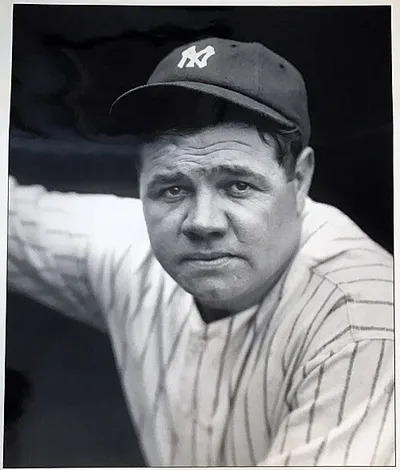
Babe Ruth
1895–1948 · American baseball player with brief film appearances as a performer
Biography
George Herman “Babe” Ruth was an American professional baseball player who competed in Major League Baseball from 1914 to 1935 and is often regarded as the greatest player in the sport's history. He first made his name as a left-handed pitcher for the Boston Red Sox and later as a slugging outfielder for the New York Yankees. His screen work was limited: he appeared in a handful of productions, usually as himself, but his lasting presence on film comes from his status as an American cultural icon.
Born in 1895 in Baltimore's Pigtown neighborhood to a family of German descent, Ruth was sent at the age of seven to St. Mary's Industrial School for Boys, a Catholic reformatory and orphanage, where he spent much of his childhood and learned the game. He signed with the minor-league Baltimore Orioles in 1914 and was soon sold to the Red Sox. He won games as a pitcher and helped Boston to World Series titles, but he wanted to play every day and was converted to the outfield. In 1919 he hit 29 home runs, a single-season record at the time.
In 1920 he was traded to the Yankees in a deal that sports historians still consider one of the worst in American sports; the money helped Red Sox owner Harry Frazee finance his Broadway productions. In New York he hit 54 home runs in his first season and reached 60 in 1927, as part of the lineup known as Murderers' Row. Yankee Stadium, opened in 1923, became known as “The House That Ruth Built.” With the Yankees he won seven American League pennants and four World Series. His swing helped make the home run central to the modern game. Off the field, his public life was shaped by fame, drinking, gambling and scandal.
After the 1934 season he moved to the Boston Braves, where he retired in 1935 with 714 home runs. He hoped to manage a major league club but never got the chance. In his final years he made many public appearances, especially in support of the American war effort during World War II. He was inducted into the Baseball Hall of Fame in 1936 and died of throat cancer in 1948. He remains a central figure in American culture, and film has recalled him in works such as The Pride of the Yankees.
Key films
- The Pride of the Yankees (1942): a biopic about Lou Gehrig in which Ruth appears in a brief role as a real figure of the Yankees era.
- Speedy (1928): a comedy directed by Ted Wilde and starring Harold Lloyd, with Ruth in a cameo as himself.
- Zelig (1983): Woody Allen's mockumentary, in which Ruth appears among real historical figures.
Trivia
The sale to the Yankees
In 1920 the Red Sox traded him to the Yankees for $125,000 in cash and another $300,000 in considerations, money that owner Harry Frazee used to finance his Broadway productions.
The 1932 gesture
In the 1932 World Series against the Cubs, according to tradition, he pointed toward center field before hitting a home run; what the gesture meant is still debated.
On Cinematopedia
 The Pride of the Yankees
 Zelig
 Speedy
Original Cinematopedia text based on Wikipedia (es) and Wikipedia (en) and Wikidata.