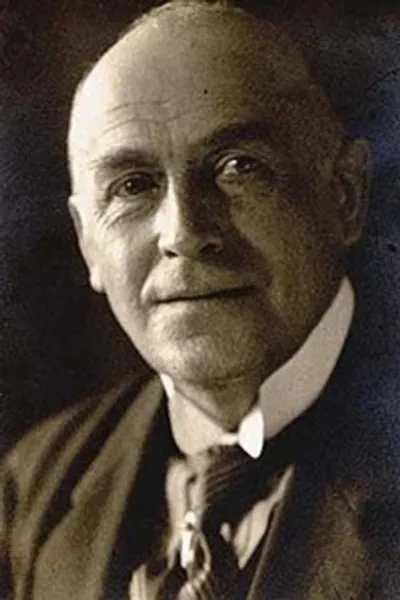
August Blom
1869–1947 · Danish film director, actor and producer of the silent era
Biography
Martin August Blom (Copenhagen, 1869 – 1947) was a Danish director, actor and producer and one of the central figures of silent cinema in his country. His name is closely tied to the golden age of Danish film between 1910 and 1914, when Nordisk Film reached a wide audience.
Blom started out as a stage actor in Kolding in 1893 and was a company actor at the Folketeatret from 1907 to 1910. During those years he also began appearing in films for Nordisk Film, and in 1910 he made his directing debut there with Livets Storme. That same year he became the company's head of production. He directed 78 films during the golden age and more than a hundred titles before leaving Nordisk and filmmaking in 1925, making him the most prolific Danish director of his era.
In 1911 he directed Ved Faengslets Port, a film that helped shape the erotic melodrama, which became the company's most profitable genre. His most ambitious project was Atlantis (1913), based on a novel by Gerhart Hauptmann and considered the first multi-reel feature shot in Denmark. He is also credited with using cross-cutting, mirrors to heighten drama and light to convey mood.
After retiring he opened the Kinografen cinema, later renamed the Bristol Theater, which he ran from 1934 until his death in Copenhagen in 1947. His legacy is that of a prolific craftsman rather than a genius, as one contemporary critic put it.
Key films
- Livets Storme (1910), his directing debut at Nordisk Film and the start of his golden-age output.
- Den hvide Slavehandel (The White Slave Trade, 1910), one of the titles that best reflects his early work.
- Ved Faengslets Port (1911), an erotic melodrama that set the direction for the studio's genre films.
- Verdens Undergang (The End of the World, 1916), a disaster film made during the First World War.
- Atlantis (1913), his most ambitious work, about the sinking of an ocean liner and a major box-office success.
Trivia
A critic judged him frankly
In his obituary, Harald Engberg of the newspaper Politiken wrote that Blom knew he was no directorial genius, but proved to be the cleverest and most tasteful scene creator of his day.
A cinema bearing his stamp
After retiring he opened the Kinografen, later renamed the Bristol Theater, and ran it from 1934 to 1947.
Two marriages
He married Agnete von Prangen in 1908, a union that ended in divorce, and in 1917 he married the actress Johanne Fritz-Petersen, widow of theatre director Fritz Petersen.
On Cinematopedia
 The End of the World
 Atlantis
 A Victim of the Mormons
 The Vampire Dancer
Original Cinematopedia text based on Wikipedia (es) and Wikipedia (en) and Wikidata.