
Armando Trovajoli
1917–2013 · Italian composer, conductor and pianist
Biography
Armando Trovajoli (Rome, 1917 – Rome, 2013), also credited as Trovaioli, was an Italian composer, conductor and pianist best known for his film scores. Although cinema defined much of his career, he also worked in radio, jazz and the musical theatre. He remained active for more than six decades, and his music accompanied much of Italian comedy in the postwar years and the anthology films of the 1960s and 1970s.
After graduating from the Accademia Nazionale di Santa Cecilia in Rome in 1948, he was given charge of a light music orchestra by RAI, the Italian public broadcaster. In the early 1950s he worked with Piero Piccioni on the radio programme Eclipse, whose refined, sophisticated style was unusual for radio orchestras of the period. His film debut came with Bitter Rice, Giuseppe De Santis's film, scored together with Goffredo Petrassi. In 1951 Dino De Laurentiis brought him in for Anna, directed by Alberto Lattuada, whose song El Negro Zumbón became an international hit.
He went on to work with directors such as Dino Risi, Vittorio De Sica and Ettore Scola. With De Sica he scored Two Women, Marriage Italian Style and Yesterday, Today and Tomorrow, and with Scola, A Special Day and We All Loved Each Other So Much. His style blended jazz with an elegant, light orchestration suited to Italian comedy. He also wrote successful musicals, including Rugantino and Aggiungi un posto a tavola.
His best-known song outside Italy is L'amore dice ciao, from the 1968 film The Libertine. He received the Order of Merit of the Italian Republic and the David di Donatello award. He died at his home in Rome in February 2013, aged 95, and his work remains a reference point for studies of Italian cinema.
Key films
- Two Women (1960), by Vittorio De Sica: a dramatic score for the story of a mother and daughter during the Second World War.
- Marriage Italian Style (1964), by Vittorio De Sica: one of his best-known collaborations with De Sica, starring Sophia Loren and Marcello Mastroianni.
- Yesterday, Today and Tomorrow (1963), by Vittorio De Sica: three comic episodes with a light score that helped its popularity.
- Scent of a Woman (1974), by Dino Risi: a melancholy drama whose music reinforces its portrait of its protagonist.
- A Special Day (1977), by Ettore Scola: his score accompanies an encounter between two characters in Rome in 1938.
- We All Loved Each Other So Much (1974), by Ettore Scola: one of the central films of Scola's career, with music by Trovajoli.
Trivia
A song in Kill Bill
One of his songs appears in Quentin Tarantino's Kill Bill films.
An international hit from Anna
El Negro Zumbón, from the film Anna, became an international success. In the film Silvana Mangano lip-syncs and dances to it, while the singing voice belongs to Flo Sandon's.
On Cinematopedia
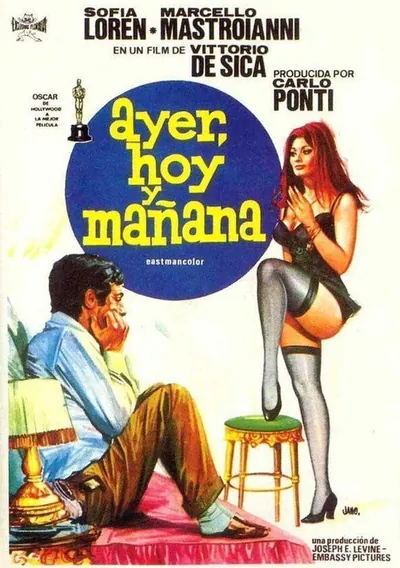 Yesterday, Today and Tomorrow1963
 Two Women1960
 The Family1987
 Marriage Italian Style1964
 A Special Day1977
 Scent of a Woman1974In the Name of the Pope King1977In the Name of the Pope King1977
 We All Loved Each Other So Much1974
 I nuovi mostri1977
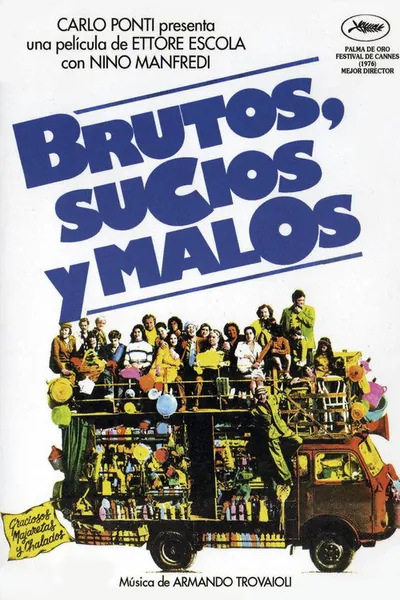 Down and Dirty1976
 I Mostri1963
 Treasure of San Gennaro1966
- The Trade in White Women 1952 · music
- Two Nights with Cleopatra 1953 · music
- The Unfaithfuls 1953 · music
- A Day in Court 1953 · music
- Of Life and Love 1954 · music
- The Widower 1959 · music
- Poor Millionaires 1959 · music
- Winter Holidays 1959 · music
- Two Women 1960 · music
- Il carro armato dell'8 settembre 1960 · music
- Atom Age Vampire 1960 · music
- Hercules in the Haunted World 1961 · music
- Hercules and the Conquest of Atlantis 1961 · music
- Mole Men Against the Son of Hercules 1961 · music
- Totò, Peppino e... la dolce vita 1961 · music
- Slave of Rome 1961 · music
- Ten Italians for One German 1962 · music
- Toto and Peppino Divided in Berlin 1962 · music
- The Four Monks 1962 · music
- Alone Against Rome 1962 · music
- Il mio amico Benito 1962 · music
- Yesterday, Today and Tomorrow 1963 · music, cast
- I Mostri 1963 · music
- The Visit 1963 · music
- The Monk of Monza 1963 · music
- The Thursday 1963 · music
- The Scapegoat 1963 · music
- Gli onorevoli 1963 · music
- Marriage Italian Style 1964 · music
- Attack and Retreat 1964 · music
- The Dolls 1964 · music
- Let's Talk About Women 1964 · music
- The Magnificent Cuckold 1964 · music
- High Infidelity 1964 · music
- Il Gaucho 1964 · music
- My Wife 1964 · music
- What Ever Happened to Baby Toto? 1964 · music
- I complessi 1965 · music, cast
- Seven Golden Men 1965 · music
- Assassination in Rome 1965 · music
- Treasure of San Gennaro 1966 · music
- Sex Quartet 1966 · music
- Col cuore in gola 1966 · music
- The Devil in Love 1966 · music
- Adultery Italian Style 1966 · music
- Our Husbands 1966 · music
- Seven Golden Men Strike Again 1966 · music
- Long Days of Vengeance 1967 · music
- Spy Today, Die Tomorrow 1967 · music
- Maigret in Pigalle 1967 · music
- Operation St. Peter's 1967 · music
- Will Our Heroes Be Able to Find Their Friend Who Has Mysteriously Disappeared in Africa? 1968 · music
- The Libertine 1968 · music
- Torture Me But Kill Me with Kisses 1968 · music
- Mr. Kinky 1968 · music
- Anyone Can Play 1968 · music
- The Conspirators 1969 · music
- Police Chief Pepe 1969 · music
- Seven Times Seven 1969 · music
- I See Naked 1969 · music
- Normal Young Man 1969 · music
- How, When and with Whom 1969 · music
- Where Are You Going All Naked? 1969 · music
- The Pizza Triangle 1970 · music
- May Morning 1970 · music
- The Swinging Confessors 1970 · music
- The Priest's Wife 1971 · music
- My Name Is Rocco Papaleo 1971 · music
- That's How We Women Are 1971 · music
- The Valachi Papers 1972 · music
- The Most Wonderful Evening of My Life 1972 · music
- The Italian Connection 1972 · music
- How Funny Can Sex Be? 1973 · music
- Rugantino 1973 · music
- Love and Gymnastics 1973 · music
- La Tosca 1973 · music
- The Sensual Man 1973 · music
- Scent of a Woman 1974 · music
- We All Loved Each Other So Much 1974 · music
- Bitter Love 1974 · music
- Duck in Orange Sauce 1975 · music
- The Virgin Wife 1975 · music
- Down and Dirty 1976 · music
- The Career of a Chambermaid 1976 · music
- Evil Thoughts 1976 · music
- Strange Shadows in an Empty Room 1976 · music
- Basta che non si sappia in giro 1976 · music
- As of Tomorrow 1976 · music
- A Special Day 1977 · music
- In the Name of the Pope King 1977 · music
- I nuovi mostri 1977 · music
- Wifemistress 1977 · music
- My Loves 1978 · music
- Betrayed 1979 · music
- Dr. Jekyll Likes Them Hot 1979 · music
- The Terrace 1980 · music
- Arrivano i bersaglieri 1980 · music
- Passion of Love 1981 · music
- That Night in Varennes 1982 · music
- Grand Hotel Excelsior 1982 · music
- Il paramedico 1982 · music
- Viuuulentemente mia (Mine with Violence) 1982 · music
- Sing Sing 1983 · music
- Dagger Eyes 1983 · music
- Frankenstein 90 1984 · music
- Macaroni 1985 · music
- A Thorn in the Heart 1986 · music
- The Family 1987 · music
- What Time Is It? 1989 · music
- Splendor 1989 · music
- Captain Fracassa's Journey 1990 · music
- Mario, Maria and Mario 1993 · music
- The Story of a Poor Young Man 1995 · music
- Marcello Mastroianni: I Remember 1997 · music
- The Dinner 1998 · music
- Unfair Competition 2001 · music
- People of Rome 2003 · music
Original Cinematopedia text based on Wikipedia (es) and Wikipedia (en) and Wikidata.