
Anna May Wong
1904–1961 · American actress of Chinese descent, the first Chinese-American film star in Hollywood
Biography
Anna May Wong (January 3, 1905 – February 3, 1961) was an American actress of Chinese descent, regarded as the first Chinese-American film star in Hollywood and the first Chinese American actress to gain international recognition. Her career spanned silent and sound film, as well as vaudeville, stage, radio and television. She was also a well-known fashion icon in the 1920s and 1930s. Sources differ on her year of birth, with some giving 1904.
The daughter of second-generation Chinese American parents, she grew up in a Los Angeles neighborhood close to Chinatown. Already hooked on movies as a child, she resolved at eleven to become an actress and chose the stage name by which she became known. She worked as an extra from 1919, appearing in The Red Lantern, and in 1922 she took the lead in The Toll of the Sea, one of the earliest films in color. In 1924 she appeared alongside Douglas Fairbanks in The Thief of Bagdad, which brought her international fame. She was among the first to embrace the flapper look, and in 1934 the Mayfair Mannequin Society of New York named her the world's best dressed woman.
Frustrated by the stereotyped supporting parts Hollywood offered her, she left for Europe in 1928, where she worked on stage and starred in Piccadilly (1929). Back in the sound era she appeared in Daughter of the Dragon (1931) and in Josef von Sternberg's Shanghai Express (1932), opposite Marlene Dietrich. In 1935 she was passed over for the film version of The Good Earth, and MGM cast Luise Rainer in yellowface as O-Lan. The reasons remain debated: one biographer links the decision to the Hays Code, while others have not confirmed that theory. After a year in China, she made B movies for Paramount in the late 1930s, portraying Chinese and Chinese American characters more sympathetically.
During the Second World War she devoted much of her time to supporting China against Japan. In the 1950s she returned to the screen through television, and in 1951 she starred in The Gallery of Madame Liu-Tsong, the first American television series headlined by an Asian American actress. She died of a heart attack in 1961, while preparing a return to film in Flower Drum Song. For decades she was remembered mainly for the "Dragon Lady" and "Butterfly" stereotypes, but around the centenary of her birth her work was reassessed in books and retrospectives. She is now regarded as a pioneer of Asian representation in American film.
Key films
- The Thief of Bagdad (1924), opposite Douglas Fairbanks, one of her most widely seen international films.
- The Toll of the Sea (1922), one of the first color films and her first leading role.
- Piccadilly (1929), made in Europe after she left Hollywood.
- Daughter of the Dragon (1931), one of her early sound-era American films.
- Shanghai Express (1932), directed by Josef von Sternberg, opposite Marlene Dietrich.
Trivia
The world's best dressed woman
In 1934 the Mayfair Mannequin Society of New York voted her the world's best dressed woman. Her fame as a fashion icon ran alongside her acting career.
The role of O-Lan
In 1935 MGM did not consider her for the lead in The Good Earth, which went to Luise Rainer in yellowface. It is often cited as the biggest disappointment of her career.
A television first
In 1951 she headed The Gallery of Madame Liu-Tsong, the first American television show starring an Asian American actress.
On Cinematopedia
 Shanghai Express1932
 The Thief of Bagdad1924
 Peter Pan1924
 The Devil Dancer1927
 Elstree Calling1930
 The Savage Innocents1960
 The Toll of the Sea1922
 A Study in Scarlet1933
 Across to Singapore1928
 Mr. Wu1927
 Impact1949
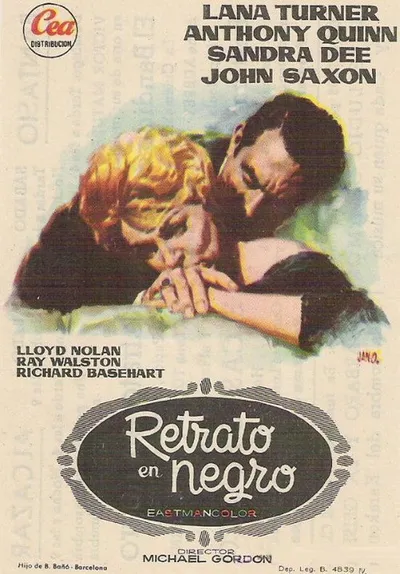 Portrait in Black1960
- Shame 1921 · cast
- The Toll of the Sea 1922 · cast
- Drifting 1923 · cast
- The Thief of Bagdad 1924 · cast
- Peter Pan 1924 · cast
- The Devil Dancer 1927 · cast
- Mr. Wu 1927 · cast
- Old San Francisco 1927 · cast
- Across to Singapore 1928 · cast
- Song 1928 · cast
- Piccadilly 1929 · cast
- Pavement Butterfly 1929 · cast
- Elstree Calling 1930 · cast
- The Road to Dishonour 1930 · cast
- Daughter of the Dragon 1931 · cast
- Shanghai Express 1932 · cast
- A Study in Scarlet 1933 · cast
- Limehouse Blues 1934 · cast
- Chu Chin Chow 1934 · cast
- Daughter of Shanghai 1937 · cast
- Bombs Over Burma 1943 · cast
- Impact 1949 · cast
- The Savage Innocents 1960 · cast
- Portrait in Black 1960 · cast
Original Cinematopedia text based on Wikipedia (es) and Wikipedia (en) and Wikidata.