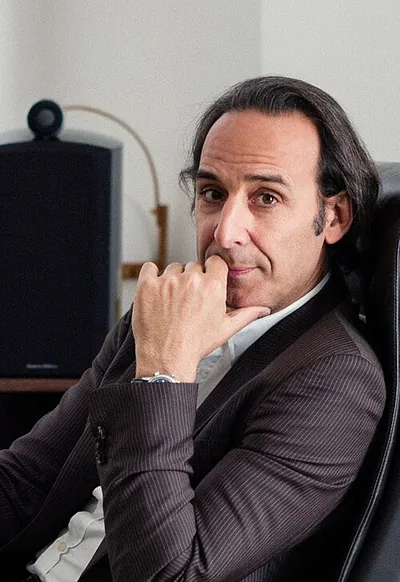
Alexandre Desplat
b. 1961 · French film composer and conductor
Biography
Alexandre Desplat (born in Paris in 1961) is a French film composer and conductor whose work has shaped film scoring across two decades. He has won two Academy Awards for Best Original Score, for The Grand Budapest Hotel and The Shape of Water, and his name is linked to a body of work that moves easily between small independent films and large commercial productions. Beyond cinema, he has written for the theatre, television, ballet and advertising, and has composed songs for several singers and actors.
Desplat's parents were a Frenchman from Sarlat-la-Canéda and a Greek poet from Athens. They met in the United States while both were students at the University of California, Berkeley, married in San Francisco, and settled in Paris. He started on the piano at five, took up the trumpet, and switched to the flute at nine. His tastes were broad, from Maurice Ravel and Claude Debussy to jazz and world music. His first exposure to film scores came through the soundtracks his parents brought back from America, and as a teenager he collected Bernard Herrmann's music for Hitchcock. He decided to become a film composer after hearing John Williams's score for Star Wars in 1977. Other early influences included Maurice Jarre, Nino Rota and Georges Delerue.
His training was that of a conservatory composer. He studied musical analysis with Claude Ballif at the Conservatoire de Paris and took a summer course with Iannis Xenakis. In Los Angeles he worked with Jack Hayes, who introduced him to the recording world of Hollywood. While recording the music for his first film he met the violinist Dominique Lemonnier, who became his favourite soloist and artistic director, and whom he later married. Alongside his film work he has played and recorded jazz and bossa nova with musicians from other countries, and he has given master classes at La Sorbonne and the Royal College of Music in London.
His early career was mostly in French cinema, where he scored dozens of films during the 1990s and early 2000s. Several of these earned César nominations, including Un Héros Très Discret (1996) and Sur mes lèvres (2002), directed by Jacques Audiard, with whom he would work again. His breakthrough in Hollywood came in 2003 with Girl with a Pearl Earring, a drama set in seventeenth-century Delft around a fictional muse of Vermeer. Then came Syriana (2005), The Painted Veil, which won him the Golden Globe for Best Original Score, and The Queen (2006), directed by Stephen Frears, which earned his first Academy Award nomination. In 2007 he scored The Golden Compass and Ang Lee's Lust, Caution. In 2008 came The Curious Case of Benjamin Button, David Fincher's film, which gave him a second Oscar nomination.
Desplat also became known for large franchises and blockbusters. He scored Harry Potter and the Deathly Hallows – Part 1 (2010) and Part 2 (2011), the latter earning a Grammy nomination, after returning to work with David Yates. He scored The Twilight Saga: New Moon (2009) as well. His collaborations with very different directors are central to his reputation. With Wes Anderson he made Fantastic Mr. Fox (2009) and The Grand Budapest Hotel (2014); with Terrence Malick, The Tree of Life (2011); with Roman Polanski, The Ghost Writer (2010); with George Clooney, The Ides of March (2011); with Stephen Frears, Philomena (2013) and The King's Speech (2010); and with Gareth Edwards, Godzilla (2014). Argo (2012) brought Oscar, Golden Globe and BAFTA nominations. His score for The Imitation Game (2014) was also Oscar-nominated, and his win that year over another of his own scores was a rare event in the history of the awards.
His concert work is equally extensive. He has conducted his music with the London Symphony Orchestra, the Royal Philharmonic Orchestra and the Munich Symphony Orchestra. His first Concerto for Flute and Orchestra premiered in France in 2013, and he wrote Trois Études for piano, originally for Lang Lang. He has written music for the Comédie-Française and songs sung by artists such as Kate Beckinsale, Charlotte Gainsbourg, Catherine Ringer and Akhenaton. In 2014 it was announced that he would head the jury of the Venice International Film Festival. In 2016 he was made an Officer of the Ordre national du Mérite and a Commander of the Ordre des Arts et des Lettres, and in 2011 he had been named a Chevalier of the Legion of Honour.
Desplat remains very active. In 2016 he stepped down from scoring the first anthology film of the new Star Wars films, Rogue One, because reshoots left him unavailable, and Michael Giacchino replaced him. In 2018 he won his second Academy Award for The Shape of Water, directed by Guillermo del Toro, who later invited him to work on Pinocchio. Little Women (2019) brought another Oscar nomination, and he has continued to collaborate with Wes Anderson on films such as Isle of Dogs. He keeps studios in Los Angeles and Paris and lives in Paris, and he is the father of two daughters. His legacy lies in scores admired by critics and in a style that supports a story without overwhelming it.
Key films
- The King's Speech (2010)
- The Shape of Water (2017)
- The Grand Budapest Hotel (2014)
- Argo (2012)
- The Curious Case of Benjamin Button (2008)
- The Imitation Game (2014)
Trivia
An Oscar against his own score
In 2014 his score for The Grand Budapest Hotel beat another of his scores from that year, The Imitation Game, a rare event in the history of the awards.
Handover on Star Wars
In 2015 it was announced that he would score Rogue One, the first anthology film of the new Star Wars films. In 2016 he left the project because reshoots left him unavailable, and Michael Giacchino replaced him.
A second chance with Harry Potter
David Yates offered him the score for the second part of Harry Potter and the Deathly Hallows after his work on the first part, which, according to accounts, enchanted everyone in the control room.
On Cinematopedia
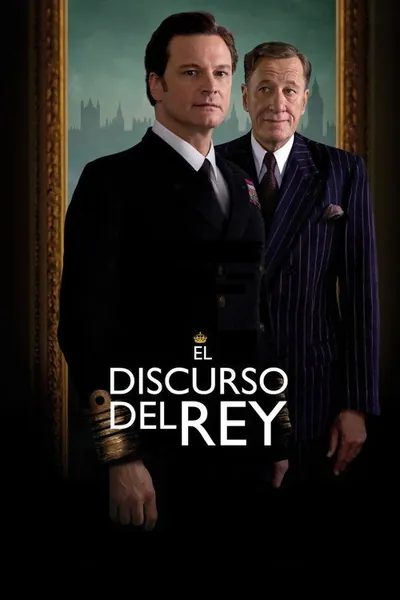 The King's Speech2010
 The Shape of Water2017
 Argo2012
 The Curious Case of Benjamin Button2008
 Harry Potter and the Deathly Hallows – Part 22011
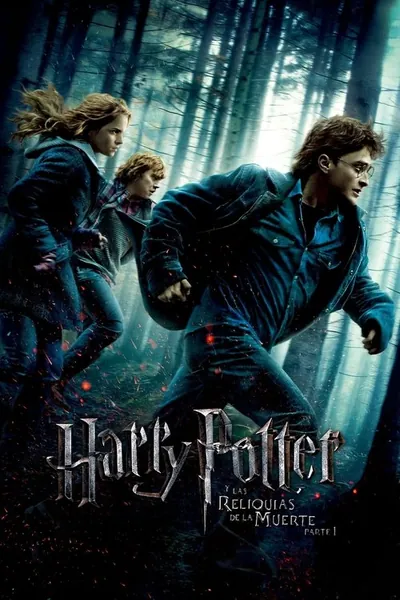 Harry Potter and the Deathly Hallows – Part 12010
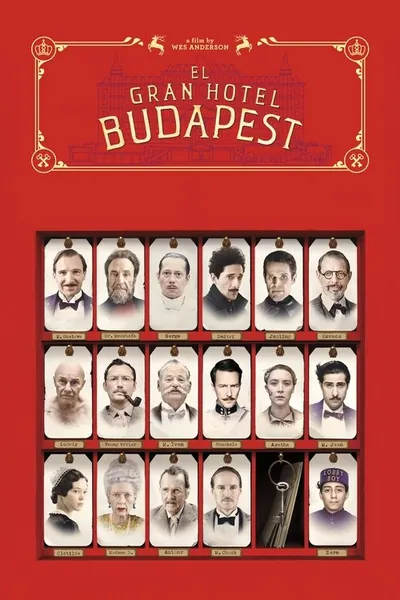 The Grand Budapest Hotel2014
 The Imitation Game2014
 The Tree of Life2011
 The Queen2006
 The Ghost Writer2010
 Zero Dark Thirty2012
- The Hour of the Pig 1993 · music
- See How They Fall 1994 · music
- Innocent Lies 1995 · music
- A Self Made Hero 1996 · music
- Une chance sur deux 1998 · music
- Empty Days 1999 · music
- The Luzhin Defence 2000 · music
- Amazon 2000 · music
- Read My Lips 2001 · music
- A Hell of a Day 2001 · music
- The Nest 2002 · music
- Girl with a Pearl Earring 2003 · music
- Eager Bodies 2003 · music
- The Pact of Silence 2003 · music
- Birth 2004 · music
- The Corsican File 2004 · music
- Syriana 2005 · music
- Casanova 2005 · music
- The Beat That My Heart Skipped 2005 · music
- Hostage 2005 · music
- The Upside of Anger 2005 · music
- The Queen 2006 · music
- The Painted Veil 2006 · music
- Firewall 2006 · music
- The Valet 2006 · music
- The Singer 2006 · music
- The Golden Compass 2007 · music
- Lust, Caution 2007 · music
- Mr. Magorium's Wonder Emporium 2007 · music
- Intimate Enemies 2007 · music
- The Curious Case of Benjamin Button 2008 · music
- Largo Winch 2008 · music
- Afterwards 2008 · music
- The Twilight Saga: New Moon 2009 · music
- Julie & Julia 2009 · music
- Coco Before Chanel 2009 · music
- A Prophet 2009 · music
- Chéri 2009 · music
- The Army of Crime 2009 · music
- The King's Speech 2010 · music
- Harry Potter and the Deathly Hallows – Part 1 2010 · music
- The Ghost Writer 2010 · music
- Tamara Drewe 2010 · music
- Harry Potter and the Deathly Hallows – Part 2 2011 · music
- The Tree of Life 2011 · music
- Extremely Loud & Incredibly Close 2011 · music
- My Week with Marilyn 2011 · music
- The Ides of March 2011 · music
- Carnage 2011 · music
- A Better Life 2011 · music
- Largo Winch II 2011 · music
- The Well-Digger's Daughter 2011 · music
- Argo 2012 · music
- Zero Dark Thirty 2012 · music
- Moonrise Kingdom 2012 · music
- Rust and Bone 2012 · music
- Renoir 2012 · music
- Reality 2012 · music
- My Way 2012 · music
- Philomena 2013 · music
- Lee Daniels' The Butler 2013 · music
- Venus in Fur 2013 · music
- Zulu 2013 · music
- Fanny 2013 · music
- Marius 2013 · music
- The Grand Budapest Hotel 2014 · music
- The Imitation Game 2014 · music
- Godzilla 2014 · music
- Unbroken 2014 · music
- The Monuments Men 2014 · music, cast
- The Danish Girl 2015 · music
- Suffragette 2015 · music
- Suite Française 2015 · music
- Tale of Tales 2015 · music
- Every Thing Will Be Fine 2015 · music
- Don't Tell Me the Boy Was Mad 2015 · music
- The Secret Life of Pets 2016 · music
- Florence Foster Jenkins 2016 · music
- The Light Between Oceans 2016 · music
- American Pastoral 2016 · music
- The Odyssey 2016 · music
- Alone in Berlin 2016 · music
- Heal the Living 2016 · music
- The Shape of Water 2017 · music
- Valerian and the City of a Thousand Planets 2017 · music
- Suburbicon 2017 · music
- Based on a True Story 2017 · music
- Operation Finale 2018 · music
- The Sisters Brothers 2018 · music
- Kursk 2018 · music
- Little Women 2019 · music
- The Secret Life of Pets 2 2019 · music
- An Officer and a Spy 2019 · music
- Adults in the Room 2019 · music
- The Midnight Sky 2020 · music
- Nightmare Alley 2021 · music
- The French Dispatch 2021 · music
- Eiffel 2021 · music
- The Outfit 2022 · music
- Final Cut 2022 · music
- Father & Soldier 2022 · music
- The Lost King 2022 · music
- Asteroid City 2023 · music
- Lee 2023 · music
- Nyad 2023 · music
- The Boys in the Boat 2023 · music
- The Palace 2023 · music
- The Piano Lesson 2024 · music
- Jurassic World Rebirth 2025 · music
- Frankenstein 2025 · music
- The Phoenician Scheme 2025 · music
- Eagles of the Republic 2025 · music
- The Social Reckoning 2026 · music
Original Cinematopedia text based on Wikipedia (es) and Wikipedia (en) and Wikidata.