
Adriano Celentano
b. 1938 · Italian singer-songwriter, actor and filmmaker
Biography
Adriano Celentano (born 6 January 1938) is an Italian singer-songwriter, actor, showman and filmmaker, and one of the best-selling Italian musical artists. Nicknamed Il Molleggiato, 'the springy one', for his energetic dancing, he is often credited with bringing rock and roll to Italy. His career spans records, film, and television, and he is regarded as one of the pillars of Italian popular music.
Born in Milan, in the Greco district near the Central Station, at 14 Via Cristoforo Gluck, he later gave that address to one of his best-known songs, "Il ragazzo della via Gluck" (1966). His parents came from Foggia, in Apulia, and had moved north for work. Before turning to entertainment he worked as a watchmaker. His singing career began in 1959, and his early influences included Elvis Presley, the 1950s rock and roll scene and the American comedian Jerry Lewis. He performed in cabarets and rock bands with Giorgio Gaber and Enzo Jannacci, and he later founded the record label Clan Celentano in 1962, which remains active.
His film career started on the acting side. He first appeared on screen in Lucio Fulci's Ragazzi del Juke-Box (1959), and Federico Fellini cast him as a rock and roll singer in La dolce vita (1960). He began directing in the mid-1960s. Critics most often point to his performance in Pietro Germi's Serafino (1968) as his finest work as an actor. Through the 1970s and part of the 1980s his low-budget comedies were among the top earners at the Italian box office, and they built a comic persona defined by a characteristic walk and exaggerated facial expressions. As a director he frequently worked with Ornella Muti, Eleonora Giorgi and his wife, Claudia Mori.
He has released forty albums, including twenty-nine studio records, and sold millions of discs. His best-known songs include "La coppia più bella del mondo", "Azzurro", with lyrics by Paolo Conte, and "Prisencolinensinainciusol" (1972), a song built on mock English that charted in the United States before it did in Italy. It was referenced by Ian Dury in "Reasons to Be Cheerful, Part 3" (1979), and two of his songs appear in the series Fargo. He has been a vegetarian since 2005 and has defended animal rights. He remains a familiar presence on Italian television, and his public life has included legal controversy, such as the case that followed his 1987 monologue against hunting. His legacy combines popular music, physical comedy and a career that moved easily between song, cinema and television.
Key films
- La Dolce Vita (1960): a rock and roll singer in Fellini's film, one of his first screen roles.
- Serafino (1968): directed by Pietro Germi, widely regarded as his strongest performance as an actor.
- Yuppie Du (1975): his first solo feature as director, a comedy that became a major box-office success.
- Bluff (1976): one of the 1970s comedies in which he developed his comic persona.
- Tame Me, Mr. Bachelor (1980): a comedy that typifies his commercially successful period.
- Furiously in Love (1981): a comedy from the peak of his popularity in Italian cinema.
Trivia
A nickname tied to his dancing
In Italy he is known as "Il molleggiato" (the springy one) for his energetic dancing. That explosive style fit his role as a showman, often with a frenetic streak reminiscent of Jerry Lewis.
A name on a pasta box
When Barilla introduced a corkscrew-shaped pasta in the 1970s, it was named cellentani after Celentano. Because Barilla trademarked the name, other companies call the shape cavatappi.
On Cinematopedia
 La Dolce Vita1960
 The Taming of the Scoundrel1980Madly in Love1981Madly in Love1981
 The Con Artists1976
 Asso1981
 Bingo Bongo1982
 Saturday, Sunday and Friday1979
 Serafino1968
 The Five Days1973Yuppi du1975Yuppi du1975
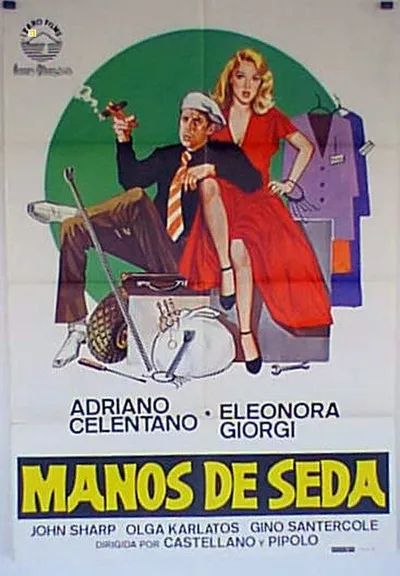 Velvet Hands1979
 Rugantino1973
- The Juke Box Kids 1959 · cast
- Juke Box - Urli d'amore 1959 · cast
- La Dolce Vita 1960 · cast
- Howlers in the Dock 1960 · cast
- The Strange Type 1963 · cast
- The Monk of Monza 1963 · cast
- The Most Beautiful Couple in the World 1967 · cast
- Serafino 1968 · cast
- Er Più – Storia d'amore e di coltello 1971 · cast
- White Sister 1972 · cast
- The Five Days 1973 · cast
- Rugantino 1973 · cast
- Little Funny Guy 1973 · cast
- Yuppi du 1975 · director, screenplay, editing, music, producer, cast
- What's Your Sign? 1975 · cast
- The Con Artists 1976 · cast
- Lunatics and Lovers 1976 · cast
- L'altra metà del cielo 1977 · music, cast
- Ecco noi per esempio 1977 · cast
- Geppo il folle 1978 · director, screenplay, editing, music, producer, cast
- Saturday, Sunday and Friday 1979 · cast
- Velvet Hands 1979 · cast
- The Taming of the Scoundrel 1980 · cast
- Give Me Five 1980 · cast
- La locandiera 1980 · cast
- Madly in Love 1981 · cast
- Asso 1981 · cast
- Bingo Bongo 1982 · cast
- Grand Hotel Excelsior 1982 · cast
- Sing Sing 1983 · cast
- Distinguishing Features: Beautiful 1983 · cast
- He Is Worse Than Me 1984 · cast
- Joan Lui 1985 · director, screenplay, editing, music, cast
- Il burbero 1986 · cast
- Jackpot 1992 · screenplay, cast
Original Cinematopedia text based on Wikipedia (es) and Wikipedia (en) and Wikidata.