Cinema Novo
15 films · 1960–1975
Cinema Novo was a movement in Brazilian film that took shape in the early 1960s and reached its greatest force between 1960 and 1968, although its influence lasted into the middle of the following decade. It brought together young filmmakers, mainly from Rio de Janeiro, Bahia and São Paulo, who wanted to make films with limited means, shot on location and focused on the reality of their country. Against a commercial industry dominated by the chanchada, the popular musical comedies of the time, and against the many Hollywood imports that filled Brazilian cinemas, they proposed a critical and personal view of Brazil in their own day.
The movement drew clearly on Italian neorealism and the French nouvelle vague. From them it took the handheld camera, non-professional actors, shooting in real places and a preference for the author over the studio system. The adaptation, however, was distinctly Brazilian. These filmmakers wanted to portray the poverty of the sertão, the tensions of the cities, the weight of popular religion and social and racial inequality, and they did not hide the modest origins of their production. As a result their films often have a rough texture, unconventional editing and a willingness to confront the audience.
The political context is inseparable from the movement. The early years of the decade coincided with a period of optimism and reform that was cut short by the military coup of 1964. Many filmmakers saw the camera as a way of analysing society and power relations, and their work engaged with debates about underdevelopment, economic dependence and the role of peasants and the urban poor. Censorship and repression tightened after 1968, and the film industry came to depend increasingly on state policy, a shift marked by the creation of Embrafilme in 1969.
Two names dominate the history of the movement. Glauber Rocha was its best-known and most controversial figure. In films such as Barravento, Black God, White Devil, Land in Anguish, Antonio das Mortes and Cabezas Cortadas he developed a baroque, allegorical and political language, and in 1965 he wrote the manifesto Aesthetics of Hunger, which argued that a cinema born from hunger and misery should be an expressive force rather than a problem to be hidden. Nelson Pereira dos Santos, closer to realism, brought Vidas Secas to the screen, an adaptation of Graciliano Ramos, and in the following years directed titles such as How Tasty Was My Little Frenchman and The Amulet of Ogum. Carlos Diegues helped shape the group and directed Os Herdeiros, a film that reflects the crisis of the elites and the critical outlook of his generation.
The movement produced other notable works, among them Macunaíma by Joaquim Pedro de Andrade, which mixes popular tradition with satire, and Garrincha: Hero of the Jungle, a portrait of the footballer that shows the group's interest in popular heroes. Its influence proved lasting. Cinema Novo showed that an auteur cinema could be built with modest resources, opened the way for later generations of Brazilian filmmakers, and left a model of political and aesthetic filmmaking that is still studied in film schools around the world.
 Black God, White Devil1964
 Entranced Earth1967
 How Tasty Was My Little Frenchman1971
 Antonio das Mortes1969
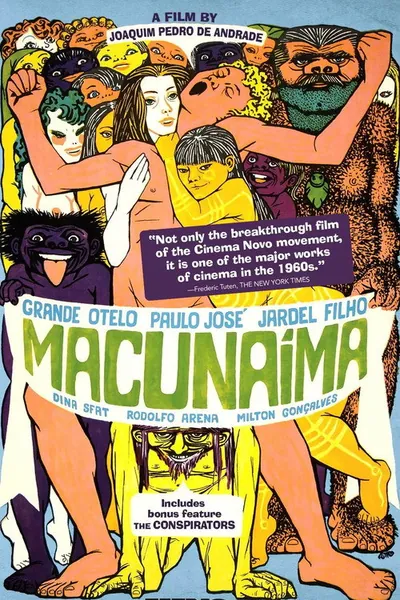 Macunaíma1969
 Barren Lives1963Barravento1962Barravento1962Severed Heads1970Severed Heads1970
 The Heirs1970
 Garrincha: Hero of the Jungle1962The Amulet of Ogum1974The Amulet of Ogum1974The Unscrupulous Ones1962The Unscrupulous Ones1962Joanna Francesa1973Joanna Francesa1973
 The Guns1964
 São Bernardo1972